- Published on
- · July 10, 2026
BDD: What Behavior-Driven Development Is
- Blog

- Renata Weber
- Renata Weber
- Growth Specialist at Pareto Plus
Growth Specialist at Pareto Plus
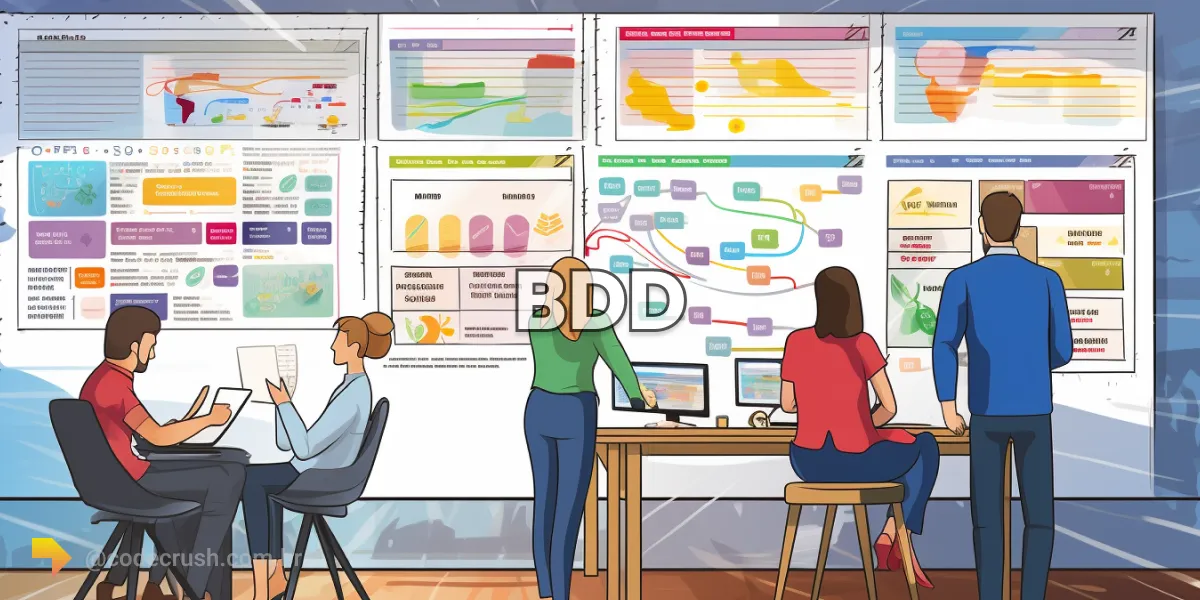
Behavior-Driven Development (BDD) is an agile methodology that specifies software by its expected behavior, in Given-When-Then scenarios written in natural language. Created by Dan North in 2006, BDD aligns business, development, and quality around the same requirements.
- What is BDD (Behavior-Driven Development)?
- How does a BDD scenario work in practice?
- What is the difference between BDD and TDD?
- Why does BDD improve team communication?
- BDD frameworks: Cucumber, JBehave, and Spock
- What are the advantages and limits of BDD?
What is BDD (Behavior-Driven Development)?
BDD is an agile development technique based on short cycles: the team describes the expected behavior of a feature in concrete scenarios, turns those scenarios into automated tests, and only then writes the code that makes them pass. The software is born validated against the client's needs, not against technical assumptions.
The approach was formalized by Dan North in the article "Introducing BDD", published in Better Software magazine in March 2006. North had been teaching TDD (Test-Driven Development) and kept seeing the same questions: where to start, what to test, what not to test, and how to name the tests. His answer was to change the vocabulary: instead of "tests," talk about "behaviors."
In North's own words: "I found the shift from thinking in tests to thinking in behaviour so profound that I started to refer to TDD as BDD" — I found the shift from thinking in tests to thinking in behavior so profound that I started referring to TDD as BDD.
In practice, BDD focuses on the observable behavior of objects and the system, not on internal implementation details. Business analysts rarely detail technical aspects, such as database storage; they describe what the system should do for the user. BDD captures exactly that description and makes it executable.
How does a BDD scenario work in practice?
A BDD scenario structures any requirement into three blocks: Given defines the initial context, When describes the event or action, and Then indicates the expected outcome. This structure is standardized by the Gherkin syntax, which according to the official Cucumber documentation has been translated into more than 70 languages — including English, with the Given, When, and Then keywords.
An example in English:
Feature: ATM withdrawal
  Scenario: Withdrawal with sufficient balance
    Given the customer has a balance of $500
    When they request a withdrawal of $200
    Then the ATM dispenses $200
    And the balance becomes $300
Each line of the scenario is linked to an automation step (step definition) written by the developer. The same text that the business analyst validates with the client runs as an automated test in the CI/CD pipeline, flagging any behavior regression. That is why BDD scenarios work as living documentation: if the text and the system diverge, the test fails.
What is the difference between BDD and TDD?
BDD does not replace TDD — it refines it. TDD, popularized by Kent Beck with the book "Test-Driven Development: By Example" (2002), guides the developer to write the unit test before the functional code. BDD builds on the same principle but changes the level of the conversation: instead of technical units, it specifies system behaviors in language the business understands.
| Aspect | TDD | BDD |
|---|---|---|
| Focus | Code units | System behavior |
| Language | Test code | Natural language (Gherkin) |
| Audience | Developers | Whole team and business |
| Starting point | A failing unit test | A behavior scenario |
| Central question | "Does the code work?" | "Does the system do what the user needs?" |
| Typical tools | JUnit, pytest, Jest | Cucumber, JBehave, Spock |
In the routine of a mature team, the two practices coexist: BDD defines acceptance scenarios from the outside in, and TDD guides the design of the inner units — often with the help of mock objects to isolate dependencies in tests. Those who want to review the conceptual basis can start with our guide on the importance of software testing.
Why does BDD improve team communication?
BDD improves communication because it forces business, development, and quality to describe the system with the same vocabulary: the so-called ubiquitous language. This language is structured around the domain model and extracted from the stories and specifications provided by the client during requirements gathering — each term in the scenario corresponds to a real concept of the business.
Before BDD, TDD alone left communication gaps: developers wrote unit tests that the quality team didn't read, while QA (Quality Assurance) validated system behavior through other paths. With Given-When-Then scenarios, everyone reads and reviews the same artifact, and the developer understands why each piece of code must exist before writing it.
Aslak Hellesøy, creator of Cucumber, summed up this spirit in a 2014 article on the official Cucumber blog: "If you think Cucumber is a testing tool, please read on, because you are wrong" — if you think Cucumber is a testing tool, you are wrong. For Hellesøy, Cucumber is first and foremost a collaboration tool, which creates shared understanding between different roles on the team; regression tests are a by-product of that collaboration.
BDD frameworks: Cucumber, JBehave, and Spock
The BDD ecosystem is dominated by frameworks that run scenarios written in natural language. The best known is Cucumber, with implementations for Java, JavaScript, Ruby, and other languages. Growth was fast: in that same 2014 article, Hellesøy recorded that Cucumber reached 1 million downloads in its first three years and 5 million downloads three years later.
In the Java community, JBehave also stands out, created by Dan North himself as the first BDD tool, and Spock, which uses Groovy to write expressive specifications with native given/when/then blocks. The choice between them depends on the project's language and how much the business team will participate in writing the scenarios — if you are still finding your footing in this vocabulary, see what frameworks are and how to choose the right one.
What are the advantages and limits of BDD?
BDD delivers four main advantages, all derived from specifying behavior before implementing:
- Better-quality code, because every feature is born with an explicit acceptance criterion.
- High cohesion and fewer bugs, since the expected behavior is continuously validated.
- Cheaper maintenance and longer lifespan, because the scenarios document the system in an always up-to-date way.
- Tests that reflect the behavior the user wants, not just the internal structure of the code.
There are, however, clear limits. Scenarios in Gherkin require constant maintenance: when the business doesn't take part in writing them, they become just an extra layer of syntax over ordinary tests, at a cost with no benefit. BDD also does not remove the need for other verification strategies, such as unit, integration, and exploratory tests. The practical rule: adopt BDD where the conversation with the business is the bottleneck, not where the challenge is purely technical.
Conclusion
BDD remains, two decades after Dan North's article, the most effective way to turn business requirements into executable specifications — but it only delivers value when the team treats scenarios as a collaboration tool, not as testing bureaucracy. If your team suffers from misinterpreted requirements and rework, start small: pick a critical feature, write three Given-When-Then scenarios with the business at the table, and automate them. Here at CodeCrush, that is our standard recommendation for teams that want to raise quality without bloating the process.
Recommended for this topic
Picked by the editors — only what we would use.
Bookcenter RJ
Kit Upgrade INTEL I5 4570 + Placa Intel H81 + Memória 8 GB+ Cooler
MultGo Oficial
Hub USB 3.0 Tipo C Adaptador 4 em 1 Premium Alta Velocidade de Transmissão
A Casa dos Importados
Hub Usb 2.0 c/7 Portas Pen Drive Teclado 480mbps Hd
## faq
Frequently asked questions
What is BDD for in software development?
BDD serves to align business, developers, and QA around the expected behavior of the system before implementation. Requirements become Given-When-Then scenarios in natural language, which are then turned into automated tests. This reduces rework, prevents requirement misunderstandings, and documents the software in a living, executable way.
BDD vs TDD: what is the difference?
TDD (Test-Driven Development) guides the developer with unit tests written before the code, focused on technical units. BDD broadens the idea: it describes the system''s behavior in natural language, also involving analysts and QA. BDD does not replace TDD; the two practices complement each other in the same project.
What do Given, When, and Then mean?
They are the three keywords that structure a BDD scenario: Given defines the initial context, When describes the action or event, and Then indicates the expected outcome. In Gherkin syntax, these scenarios can be written in English and executed as automated tests by tools like Cucumber.
Which tools to use to apply BDD?
Cucumber is the best-known BDD tool, with support for Java, JavaScript, Ruby, and other languages. The Java ecosystem also highlights JBehave, created by Dan North, and Spock, based on Groovy. All of them execute scenarios written in natural language and integrate with test automation pipelines.
Is it worth adopting BDD in 2026?
It is worth it when there is real collaboration between business and development: scenarios become executable specification and living documentation. In purely technical teams, without business participation, the cost of maintaining scenarios in Gherkin can outweigh the gain — in that case, traditional automated tests with TDD tend to be enough.
Topics in this article
## continue lendo
Artigos relacionados


Keep browsing
Previous article

Junior, mid-level, and senior dev: the real difference
A junior dev needs supervision, a mid-level works autonomously, and a senior leads complex projects, mentors the team, and makes architecture decisions.
Read moreNext article

What is Power BI and what it is for in data analysis
Power BI is Microsoft''s business intelligence suite that turns raw data into interactive dashboards and reports for data-driven decisions.
Read moreAbout the author