- Published on
- · July 10, 2026
Computational Immunology: What It Is and How It Works
- Blog

- Ana Carolina Guedes
- Ana Carolina Guedes
- AI Specialist
AI Specialist
Computational immunology is the field that brings together computer science and biology to study the immune system through bioinformatics, mathematical models, and machine learning. It is used to predict immune responses, accelerate vaccine design, and investigate autoimmune and infectious diseases.
- What is computational immunology?
- Why study the immune system with computing?
- How does computational immunology work?
- What are the main cells of the human immune system?
- Tools and languages to get started in the field
- Challenges and the future of computational immunology
- Conclusion
What is computational immunology?
Computational immunology, also called systems immunology, involves the development and application of bioinformatics methods, mathematical models, and statistical techniques to study the biology of the immune system, or parts of it. Instead of observing each component in isolation, the field treats the immune system as an integrated network of cells and signals that can be modeled and simulated.
The journal Nature Reviews Immunology, in the article "Real and artificial immune systems: computing the state of the body", already described the immune system as a "computing system" that continuously evaluates the state of the body — a metaphor that helps explain why it is so modelable. A 2025 review published in Frontiers in Immunology reinforces that high-resolution omics technologies, combined with computational modeling and machine learning, are creating new ways to understand immunological dynamics as a whole.
Why study the immune system with computing?
Studying the immune system with computing is necessary because it is too complex to be understood purely experimentally. A study published in PNAS in 2023 estimated that the human body harbors about 1.8 trillion immune cells, with an approximate mass of 1.2 kg — lymphocytes represent 40% of the total cell count, while macrophages, being large, account for nearly 50% of the mass.
This volume involves dozens of cell types and hundreds of pathways and molecular signals interacting at the same time. Computational immunology enters as a tool to investigate these mechanisms systematically. By integrating mathematical models, machine learning algorithms, and experimental data, researchers extract insights into immune dynamics that open perspectives for diagnosis, treatment, prevention, and disease prediction. The economic relevance accompanies this potential: according to Fortune Business Insights, the global immunology market was valued at 123.05 billion in 2026.
How does computational immunology work?
Computational immunology works by combining mathematical models, simulations, and data analysis techniques to predict how the immune system will react to certain conditions. This arsenal supports vaccine research and the study of autoimmune and infectious diseases, testing hypotheses on the computer before taking them to the lab. In practice, the field is organized into three main fronts.
Modeling and simulation
Computational modeling simulates complex immunological interactions that would be difficult to study experimentally. It is possible, for example, to create mathematical models that predict the body immune response to a type of vaccine. A concrete case is in the article "Modelling the Human Immune System Response to the ChAdOx1 nCoV-19 Vaccine", which models the organism reaction to a COVID-19 vaccine.
Machine learning in immunology
Machine learning and AI (Artificial Intelligence) are increasingly used to predict immunological behaviors and optimize treatments. These algorithms learn from large volumes of data to anticipate immune reactions — those who want to start here can consult the fundamentals of machine learning before applying them to biological data.
Vaccine and therapy development
Computational immunology is a powerful tool to understand the immune response to vaccines. There are several studies that use the field to investigate immunizers, such as the doctoral thesis "Computational modeling of the immune response to the yellow fever vaccine", which simulates the organism reaction to the immunization.
What are the main cells of the human immune system?
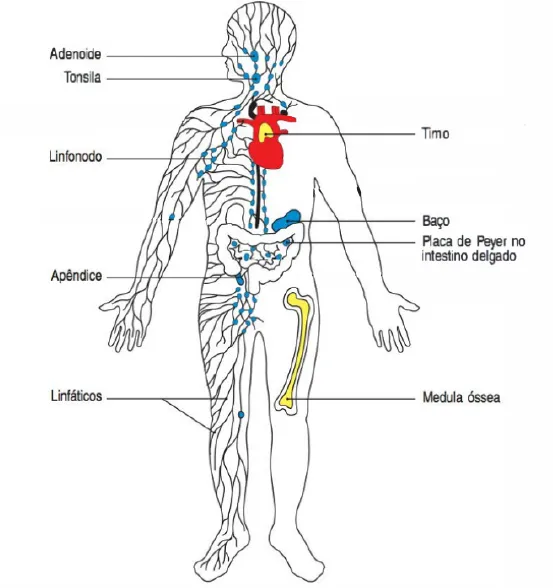
The Human Immune System (SIH) is a complex network of cells, tissues, and organs that work together to protect the body against pathogens such as bacteria, viruses, fungi, and cancer cells. It distinguishes self cells from foreign ones, eliminating only those that pose a threat, and is divided into two fronts: the innate immune system, the first line of defense, and the adaptive immune system, activated when the innate does not eliminate the pathogen.
| Characteristic | Innate immune system | Adaptive immune system |
|---|---|---|
| Speed | Immediate response | Slower response |
| Specificity | Generic, non-specific | Highly specific |
| Memory | Does not retain memory | Memorizes pathogens |
| Typical cells | Macrophages, neutrophils, NK | T and B lymphocytes |
Among the most important cells of the SIH, it is worth knowing:
- T lymphocytes — coordinate the adaptive immune response and eliminate infected cells; they subdivide into subpopulations such as CD4+ and CD8+.
- B lymphocytes — produce specific antibodies to fight antigens, sustaining the humoral immune response.
- Macrophages — perform the phagocytosis of pathogens and debris and present antigens to lymphocytes.
- Dendritic cells — capture and present antigens to T and B lymphocytes, initiating the adaptive response.
- Natural Killer (NK) cells — cytotoxic cells of innate immunity that destroy infected and tumor cells without prior activation.
- Neutrophils — the most abundant leukocytes in the blood, they act in the phagocytosis of bacteria in the early phases of the response.
Tools and languages to get started in the field
To go deeper into computational immunology, the first step is to master how the immune system itself works. A classic reference is the book Janeway Immunobiology, by Kenneth Murphy, an excellent starting point before moving on to modeling. On YouTube, talks such as "Understanding Diseases through the Use of Computational Immunology", by Marcelo Lobosco (DCC/UFJF), help connect biology and computing.
In the technical field, two languages stand out for data analysis:
- Python — the most used by the community for its clear syntax and vast ecosystem of scientific libraries, such as pandas and NumPy. If you are starting out, it is worth following a Python guide for beginners.
- R — widely adopted by researchers in statistics and bioinformatics, it is the natural choice right after Python; the R language has a strong tradition in statistical analysis.
Two habits complete the training: follow publications on Google Scholar — such as the article "A Validated Mathematical Model of the Cytokine Release Syndrome in Severe COVID-19" — and invest in English for developers, since most articles and tools are in that language. Here at CodeCrush you find supporting material for each of these fronts.
Challenges and the future of computational immunology
Despite its potential, computational immunology faces concrete obstacles that limit the accuracy of its models. Overcoming them depends as much on advances in data as on computing infrastructure. The main challenges are:
- Complexity of biological systems — modeling SIH interactions accurately is difficult due to intra- and interindividual variability and the lack of data that integrate all dimensions of the immune system.
- High processing power — models that simulate millions of interactions between cells, molecules, and signals require great computational capacity, often supported by high-performance computing and GPUs.
- Integration of multimodal data — the field depends on combining distinct types of biological and clinical data, whose heterogeneity hinders normalization, analysis, and interpretation.
- Scarcity of high-quality data — incomplete, imprecise, or biased data can lead to wrong conclusions and compromise the robustness of the models.
- Ethical and privacy issues — ensuring the ethical use of data and protecting the privacy of individuals is fundamental in a field that works with sensitive health information.
Conclusion
Computational immunology shows that biology and code no longer walk separately: modeling the immune system on the computer is today one of the most promising ways to accelerate vaccines, understand diseases, and personalize treatments. For those who program, it is a rare invitation to apply Python, R, and machine learning to one of the most fascinating systems that exist — the one that keeps us alive. If the topic excited you, start with the fundamentals of the immune system and data analysis; the rest is practice and curiosity.
Recommended for this topic
Picked by the editors — only what we would use.
A Casa dos Importados
Hub Usb 2.0 c/7 Portas Pen Drive Teclado 480mbps Hd
Bookcenter RJ
Kit Upgrade INTEL I5 4570 + Placa Intel H81 + Memória 8 GB+ Cooler
MultGo Oficial
Hub USB 3.0 Tipo C Adaptador 4 em 1 Premium Alta Velocidade de Transmissão
## faq
Frequently asked questions
What is computational immunology?
Computational immunology, or systems immunology, is the field that develops and applies bioinformatics methods, mathematical models, and statistics to study the immune system. It integrates experimental data and algorithms to systematically understand how defense cells and molecules interact and respond to pathogens, vaccines, and diseases.
What is computational immunology for?
It serves to simulate immunological interactions that are hard to observe in the lab, predict vaccine responses, optimize therapies, and investigate autoimmune and infectious diseases. By combining modeling and machine learning, it accelerates biomedical research and supports diagnostic, treatment, and prevention decisions based on data.
Which languages do I need to learn to work in the field?
Python is the most used language, thanks to its clear syntax and scientific libraries like pandas and NumPy. R comes next, widely adopted in statistics and bioinformatics. It is also essential to master English, since most articles and tools are in that language.
What is the difference between the innate and adaptive immune system?
The innate immune system is the first line of defense: it acts fast and non-specifically against any threat. The adaptive system is the second line, slower and highly specific, capable of recognizing and memorizing pathogens for faster and more effective future responses.
What are the biggest challenges of computational immunology?
The main challenges are the enormous complexity of the immune system, variability between individuals, the need for high processing power, and the scarcity of high-quality data. Integrating multimodal data and ensuring privacy and ethical use of information are also relevant obstacles.
Topics in this article
## continue lendo
Artigos relacionados



Keep browsing
Previous article

What is a pentest? Penetration testing explained
A pentest, or penetration test, is a simulated and authorized attack that looks for vulnerabilities in systems to fix them before hackers exploit them.
Read moreNext article

Kali Linux: what it is, what it is for, and how to install
Kali Linux is a Debian-based distribution, maintained by OffSec, with hundreds of pentest tools for security auditing and ethical hacking.
Read moreAbout the author