- Published on
- · July 10, 2026
What is blockchain and how does it work?
- Blog

- Henrico Piubello
- Henrico Piubello
- IT Specialist - Grupo Voitto
IT Specialist - Grupo Voitto
Blockchain is a distributed ledger technology that stores data in blocks chained by cryptography and replicated among multiple nodes. It records transactions immutably and transparently, without intermediaries, and sustains cryptocurrencies like Bitcoin and applications in finance, logistics and healthcare.
- What is blockchain?
- How does blockchain work?
- How did blockchain technology emerge?
- Why is blockchain important?
- Is blockchain secure?
- How has blockchain evolved?
- What are the components of blockchain?
- What is the difference between a database and a blockchain?
- What is the difference between Bitcoin and blockchain?
- How does blockchain differ from the cloud?
- Which sectors and companies use blockchain?
- Blockchain, token and cryptocurrency: what is the difference?
What is blockchain?
The blockchain is a distributed database mechanism that allows the transparent and verifiable sharing of information across a network. It consists of a chain of interlinked blocks, in which each block contains a set of transactions that cannot be altered without the network's consensus. It is a DLT (Distributed Ledger Technology).
Unlike a traditional database, controlled by a single entity, blockchain has no central administrator. Each participant keeps an identical copy of the ledger, and no transaction enters the chain without collective validation. This combination of decentralization, immutability and cryptography is what makes the technology trustworthy for financial transactions, property records and asset tracking.
How does blockchain work?
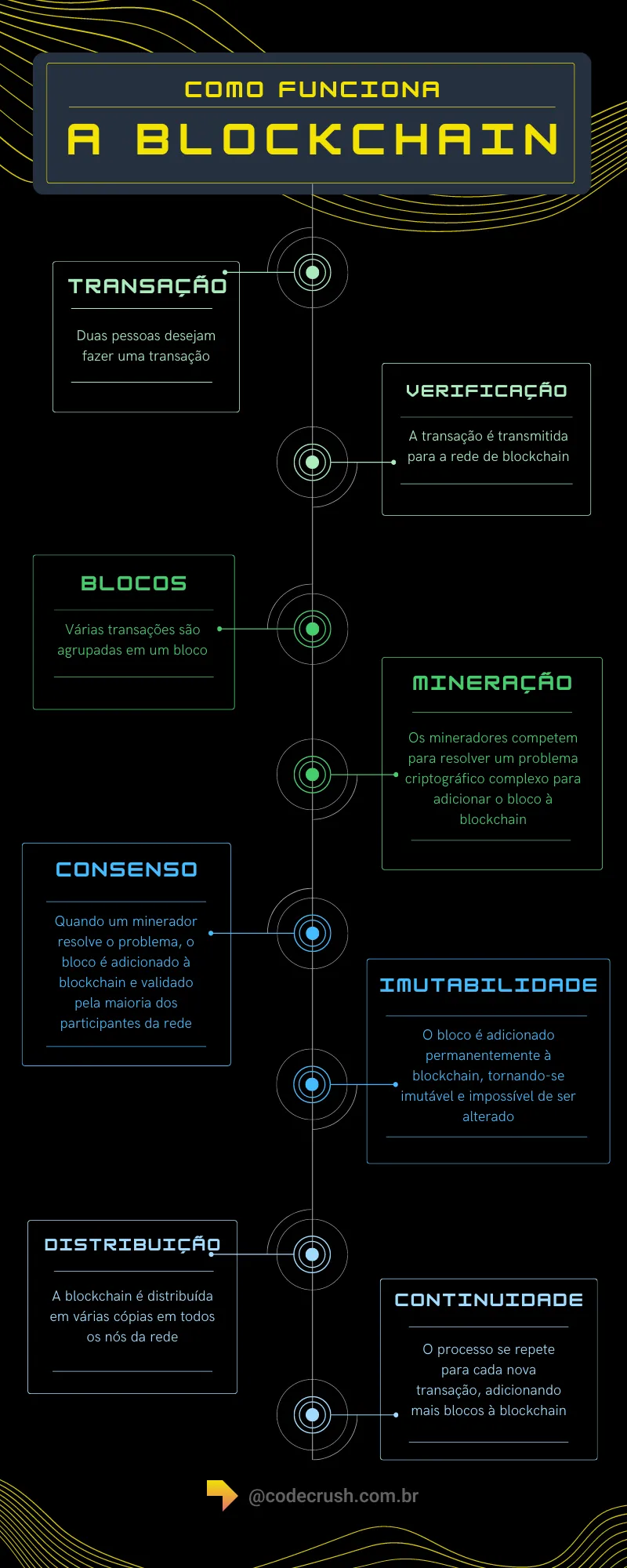
Blockchain works in four fundamental steps. First, each transaction is recorded in a block with data such as sender, recipient and amount. Then, the network seeks consensus among the participants to validate that transaction. Next, the validated block is linked to the previous one through a cryptographic hash, forming the chain. Finally, the updated ledger is shared among all nodes.
This sequence ensures the integrity and immutability of the data: since each block points to the previous one, altering a single record would require redoing all the following blocks across the entire network at the same time. The four steps are:
- Record the transaction — the operation's data is grouped into a new block.
- Obtain consensus — the nodes verify authenticity through consensus algorithms.
- Link the blocks — each block receives the hash of the previous block, creating the chain.
- Share the ledger — the updated ledger is replicated among all participants.
How did blockchain technology emerge?
Blockchain technology emerged on October 31, 2008, when Satoshi Nakamoto published the whitepaper "Bitcoin: A Peer-to-Peer Electronic Cash System". The document proposed a decentralized system for digital transactions without intermediaries, using cryptography and a network of distributed computers. On January 3, 2009, Nakamoto mined Bitcoin's genesis block, with a reward of 50 BTC, putting the network into operation.
In the whitepaper itself, Nakamoto summarizes the proposal: "A purely peer-to-peer version of electronic cash would allow online payments to be sent directly from one party to another without going through a financial institution."
Since then, blockchain has evolved far beyond cryptocurrencies. Platforms like Ethereum, Ripple and Hyperledger started allowing smart contracts, custom tokens and decentralized applications, attracting investments from companies and governments around the world.
Why is blockchain important?
Blockchain is important because it solves a central problem of traditional systems: the lack of trust between parties who do not know each other. In financial transactions, this distrust usually requires banks, notaries and other intermediaries. Blockchain replaces this intermediary with a mathematical consensus, recording and validating each operation immutably.
Without a central authority to oversee transactions, the network reduces complexity, costs and points of vulnerability. All records are updated synchronously, and any fraud attempt would be evident to the entire network. This importance translates into growing adoption in sectors such as financial services, logistics and healthcare, with Bitcoin being the best-known example.
Is blockchain secure?
Blockchain is recognized for its security thanks to the decentralized design and the use of advanced cryptography. Each transaction is verified and validated by a network of distributed nodes, which drastically reduces the risk of manipulation. Immutability reinforces this protection: once confirmed, a block is linked to the previous one by a hash, making it almost impossible to alter past records without redoing the entire chain.
The security of digital assets also depends on private keys. As long as the user keeps their key protected, only they can move their funds. Still, the technology is not infallible: there are potential vulnerabilities, such as the 51% attack, in which a group controls the majority of computing power on a proof-of-work network. For this reason, using reliable wallets and good security practices remains essential.
How has blockchain evolved?
Blockchain has evolved in three generations since 2008, each expanding its applications. The first generation was that of digital currencies; the second brought smart contracts; and the third seeks to solve scalability, interoperability and energy sustainability. This trajectory went from a simple payment system to an infrastructure for decentralized applications.
First generation: Bitcoin and virtual currencies
The first generation began with the emergence of Bitcoin, in 2008, focused on secure and transparent peer-to-peer financial transactions. Bitcoin was the pioneer in the use of blockchain and remains the best-known and most adopted cryptocurrency to this day.
Second generation: smart contracts
The second generation brought smart contracts, introduced by the Ethereum platform in 2015. These contracts are autonomous programs that execute actions when predefined conditions are met, enabling decentralized applications (dApps) and custom tokens far beyond financial transactions.
Third generation: scalability and sustainability
The third generation focuses on performance, interoperability and energy consumption, with platforms like Cardano, Polkadot and Solana. The most expressive milestone was "The Merge", on September 15, 2022, when Ethereum migrated to proof of stake and reduced its energy consumption by about 99.95%. According to ethereum.org, CCRI estimates point to a drop of approximately 99.992% in the network's carbon footprint after the transition.
What are the components of blockchain?
Blockchain is composed of three main components that work together: the distributed ledger, smart contracts and public key cryptography. Together, they guarantee security, transparency and automation without relying on trusted third parties.
Distributed ledger
The distributed ledger is the network's shared database, in which all transactions are stored immutably. Unlike a common shared file, it imposes strict rules on who can record data, preserving the integrity of the history.
Smart contracts
Smart contracts are programs stored on the blockchain that execute agreements automatically when the agreed conditions are met. They eliminate intermediaries and allow companies to self-manage commercial contracts with security and predictability.
Public key cryptography
Public key cryptography identifies each participant on the network. Each user has a public key, shared to verify the sender's identity, and a private key, kept secret to sign transactions and guarantee their authenticity.
What is the difference between a database and a blockchain?
The difference between a traditional database and a blockchain lies in structure, governance and security. A conventional database is centralized and controlled by a single entity, which defines who can read and alter the records. Blockchain is decentralized: data is replicated among nodes and only changes by majority consensus, which makes the history practically immutable.
| Aspect | Traditional database | Blockchain |
|---|---|---|
| Structure | Centralized, single server | Distributed among several nodes |
| Control | Central authority | Network consensus |
| Data alteration | Editable by the administrator | Immutable after confirmation |
| Transparency | Restricted access by permission | Public or permissioned |
| Security | Depends on the central server | Cryptography and decentralization |
While conventional databases prioritize performance and direct control, blockchain prioritizes trust and fraud resistance. There are public, private and consortium versions, which adjust the level of access according to each project's privacy needs.
What is the difference between Bitcoin and blockchain?
The difference between Bitcoin and blockchain lies in the nature of each: Bitcoin is a cryptocurrency, while blockchain is the technology that supports it. Bitcoin was the first practical application of blockchain, created to enable peer-to-peer transactions without intermediaries like banks.
Blockchain, on the other hand, is a general-purpose infrastructure. It can record any type of data securely and immutably, which opens the door to uses far beyond digital currencies, such as logistics, supply chains, property records and digital identity. In short: every Bitcoin uses blockchain, but not every blockchain involves Bitcoin.
How does blockchain differ from the cloud?
Blockchain and cloud computing solve different problems. Blockchain is a decentralized technology focused on trust and data integrity: it records transactions in a shared and immutable ledger, validated by consensus. Its focus is to ensure that no one alters or falsifies records without the network's approval.
Cloud computing is a model for delivering computing services over the internet, in which servers, storage and networks are provided on demand from data centers. Its focus is flexibility, scalability and cost reduction. The two concepts can complement each other: providers like AWS, Azure and Google Cloud offer managed blockchain services, as shown in our comparison between cloud services.
Which sectors and companies use blockchain?
Several sectors already use blockchain to gain transparency and traceability. In the financial sector, the technology speeds up payments and reduces costs; in retail and the food industry, it authenticates product origin; in energy, it enables direct trading of renewable energy; and in healthcare, it protects the integrity of medical records. Explore the topic in our guide on blockchain use cases and applications.
Large companies keep active projects:
- IBM developed Hyperledger Fabric, used by companies worldwide.
- Microsoft offered managed blockchain services in its Azure cloud infrastructure.
- J.P. Morgan created Quorum, a corporate version of Ethereum.
- Walmart uses blockchain to track product origin in its supply chain.
- Maersk and IBM developed the TradeLens maritime logistics platform.
- Binance operates one of the largest cryptocurrency exchanges in the world.
Adoption continues to expand across financial services, logistics, healthcare and energy, which reinforces the topic's relevance for anyone following technology at CodeCrush.
Blockchain, token and cryptocurrency: what is the difference?
Blockchain, token and cryptocurrency are related, but have distinct functions. Blockchain is the technology that supports the security and reliability of transactions. The token is a digital unit that represents an asset or a specific utility within a network. Cryptocurrency is a type of token that works as decentralized digital money.
In other words, blockchain is the base, the token is what circulates over it and cryptocurrency is a particular category of token. Understanding this hierarchy helps to correctly interpret web3, NFT and decentralized finance projects.
Conclusion
Blockchain has gone from being synonymous with Bitcoin to establishing itself as a digital trust infrastructure. Its differentiator is not the currency, but the ability to record data immutably, transparently and without intermediaries — something that traditional databases do not deliver. For developers and companies, the practical invitation is clear: instead of asking "does this need blockchain?", it is worth asking "is there a real trust problem here between parties who do not trust each other?". When the answer is yes, blockchain is usually the right tool; when not, a well-designed database still solves it with more simplicity.
Recommended for this topic
Picked by the editors — only what we would use.
Bookcenter RJ
Kit Upgrade INTEL I5 4570 + Placa Intel H81 + Memória 8 GB+ Cooler
A Casa dos Importados
Hub Usb 2.0 c/7 Portas Pen Drive Teclado 480mbps Hd
MultGo Oficial
Hub USB 3.0 Tipo C Adaptador 4 em 1 Premium Alta Velocidade de Transmissão
## faq
Frequently asked questions
What is blockchain for?
Blockchain is for recording transactions and data in an immutable, transparent and intermediary-free way. It is used in cryptocurrencies, supply chain tracking, smart contracts, digital identity, medical records and product authentication, offering trust in environments where the parties do not trust each other.
Are blockchain and Bitcoin the same thing?
No. Bitcoin is a cryptocurrency, the first practical application of blockchain. Blockchain is the underlying technology that records and validates Bitcoin transactions. One is the infrastructure, the other is just one of its many possible uses, alongside logistics, healthcare and finance.
Can blockchain be hacked?
Blockchain is highly resistant to attacks because of decentralization and cryptography, but it is not infallible. Proof-of-work networks are vulnerable to the 51% attack, when a group controls the majority of the computing power. Failures usually occur in wallets, contracts or poorly protected private keys.
Is it worth learning blockchain in 2026?
Yes, for those working in finance, security or web3 development, blockchain remains relevant in 2026. Banks, governments and large retailers keep active projects, and smart contracts expand the demand for developers. Mastering consensus, cryptography and platforms like Ethereum opens opportunities in a market still consolidating.
Topics in this article
## continue lendo
Artigos relacionados

Keep browsing
Previous article
7 Sites to Practice JavaScript with Real Challenges
HackerEarth, Edabit, CodinGame, Codewars, LeetCode, HackerRank and CodeChef offer free challenges to practice JavaScript online.
Read moreNext article
Types of Blockchain: Public, Private, and Consortium
Blockchain can be public, private, hybrid, or consortium: the types differ in who participates and validates transactions. See which model to choose.
Read moreAbout the author