- Published on
- · July 10, 2026
Threads: Instagram's social network and Twitter rival
- Blog

- Henrico Piubello
- Henrico Piubello
- IT Specialist - Grupo Voitto
IT Specialist - Grupo Voitto

- Renata Weber
- Renata Weber
- Growth Specialist at Pareto Plus
Growth Specialist at Pareto Plus

Threads is a microblogging social network from Meta integrated with Instagram, used for public, text-based conversations almost in real time, plus photos and videos. Launched in July 2023 as an alternative to Twitter (now X), it became the fastest-growing consumer app in history.
- What is Threads?
- How does Threads connect to Instagram?
- What are Threads' features?
- How do privacy and personalization work?
- What is fediverse compatibility (ActivityPub)?
- Threads vs Twitter (X): what are the differences?
What is Threads?
Threads is Meta's text-conversation social network, presented as a space for communities to gather and discuss any subject, from current events to future trends. Its interface and dynamics directly resemble Twitter/X, with a feed of short posts, likes, replies, and shares.
Threads' differentiator is the native tie to Instagram: on joining, the user reuses the same username, verification, and follower base already on Meta. The app also automatically suggests connections with people the user already follows on Instagram, which accelerates network formation.
Threads includes familiar features — like, repost, and comment spaces. Replies can be public or restricted to followers and mentioned profiles, and private conversations are stored in Instagram Direct, allowing interaction even with those who have not installed the app.
How does Threads connect to Instagram?
Threads connects to Instagram through the account the user already has, leveraging a base of more than 2 billion people on the photo platform. This unified login is the app's main growth engine: instead of starting from scratch, the user imports friends and followers immediately.
Before the official announcement, hints of the launch were hidden inside Instagram itself. By typing "Threads" in the search bar, a ticket icon (🎟️) appeared next to the search field. Clicking it revealed a 3D card with the new network's logo, the username, and the premiere date and time, according to Meta.
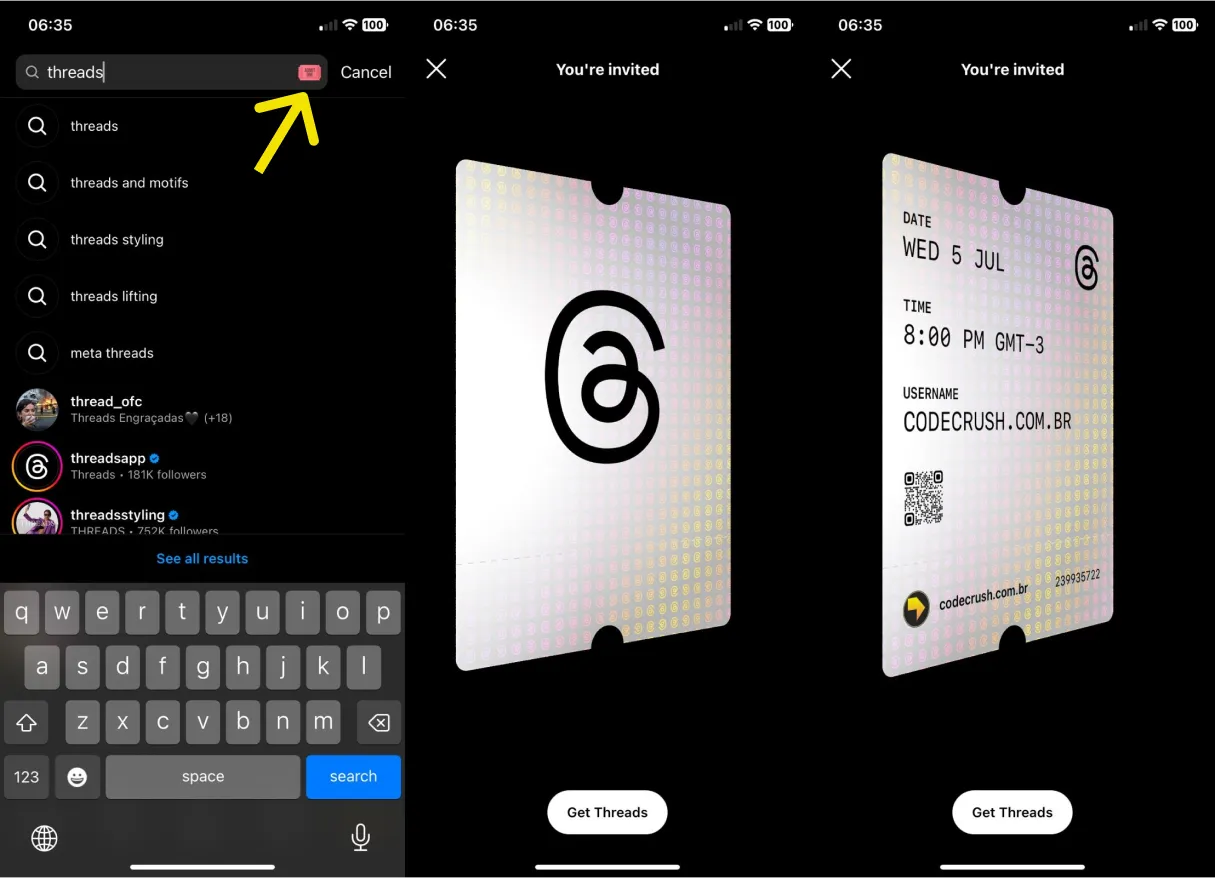
The discovery of these clues generated intense speculation on other social networks and heightened expectations around the launch — an example of how Meta uses its ecosystem to boost launches, a topic we explore when discussing the impact of big techs on the market.
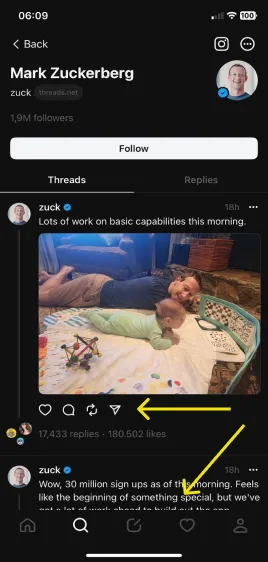
What are Threads' features?
Threads was designed to offer real-time updates and public conversations, in the same territory as platforms like Twitter/X, Bluesky, and Mastodon. The focus is text, but with robust media support.
In practice, users can publish:
- Text posts of up to 500 characters per publication.
- Photos attached to posts, single or in carousel.
- Videos up to 5 minutes long.
- External links that direct outside the app.
Besides creating content, you can like, reply, and repost other people's publications — the core interactions that sustain a conversation network. This entire social layer is built on Meta's APIs and services, in the same spirit as the Facebook Graph API that integrates the company's apps.
How do privacy and personalization work?
Privacy on Threads revolves around control over who can reply. Unlike Twitter/X, Threads did not bring a trending topics section at launch — a feature added later, as the base grew. Reply controls, however, were present from the start.
The user decides whether replies to their posts are open to everyone, restricted to followers, or limited only to mentioned profiles. The app also offers a filter to hide comments with specific terms and automatically inherits blocks from the Instagram account, reducing moderation effort.
This settings inheritance is intentional: by tying Threads and Instagram, Meta transports the safety history from one app to the other, giving the user a safer starting point without reconfiguring everything manually.
What is fediverse compatibility (ActivityPub)?
Fediverse compatibility allows Threads to exchange content with other open social networks through the ActivityPub protocol, the same one adopted by Mastodon. With this feature enabled, people on compatible servers can follow a Threads profile and see its posts even without having the app installed.
The integration advanced gradually. After starting fediverse sharing tests in 2024, Meta began allowing Threads users to follow profiles hosted on other ActivityPub servers in December 2024. This makes Threads the largest social network to adopt the open protocol.
For developers, this move is relevant: instead of a walled garden, Threads relies on an interoperable standard — a concept close to a well-documented REST API, where distinct systems communicate through public, predictable rules.
Threads vs Twitter (X): what are the differences?
The main difference is the model: Threads is born integrated with Instagram and the fediverse, while Twitter, renamed X, operates as a standalone platform with its own API. The table below summarizes the contrasts directly.
| Aspect | Threads (Meta) | Twitter / X |
|---|---|---|
| Login | Linked to Instagram | Standalone account |
| Text limit | 500 characters | 280 (more in premium) |
| Open protocol | ActivityPub (fediverse) | No |
| Video per post | Up to 5 minutes | Varies by plan |
| Starting base | Instagram followers | Own network |
This integration explains Threads' adoption speed. As Wikipedia summarizes, the app became the fastest-growing consumer app in history, by reaching 100 million users in five days — surpassing the record then held by ChatGPT. Growth remained strong: in June 2026, Meta announced about 500 million monthly active users on Threads, up from 350 million a year earlier.
If you want to dig deeper into how platforms compete for attention and engagement, it is worth reading our guide on how to succeed on social media and the analysis of Meta's connected metaverse future.
Conclusion
Threads got it right by not competing head-to-head: instead of fighting for individual users, it imported an entire network from Instagram and bet on an open standard that most rivals ignore. For content creators, this means immediate reach; for developers, it is a rare example of a big tech pushing the web toward interoperability. In practice, Threads has gone from being the anti-Twitter app to becoming the largest network in the fediverse — and that bet, more than the sign-up numbers, is what we here at CodeCrush consider Meta's most interesting move in the battle for public conversations.
Follow CodeCrush on Threads: ☞ codecrush.com.br
Recommended for this topic
Picked by the editors — only what we would use.
Liss Fashion Variedades
Roteador Tecnologia Mesh Tp-Link Dual Band AX3000 Wi-Fi 6 EX520
ELETROHALEN
Filtro De Linha Extensao Upsai FL5 5 Tomadas 1,2m Protecao Surtos Sobrecarga Bivolt Audio E Tv
A Casa dos Importados
Hub Usb 2.0 c/7 Portas Pen Drive Teclado 480mbps Hd
## faq
Frequently asked questions
What is Threads for?
Threads is for public, text-based conversations almost in real time, in the style of Twitter/X. You publish posts of up to 500 characters, photos, videos, and links, and interact with likes, replies, and reposts, all tied to your Instagram account.
Threads vs Twitter (X): what is the difference?
Threads is born integrated with Instagram and the fediverse via ActivityPub, while X is a standalone platform. Threads focuses on milder conversations and adopts an open protocol; X maintains consolidated trending topics and its own API ecosystem.
Do I need Instagram to use Threads?
Yes. Logging into Threads depends on an Instagram account, which defines your username, verification, and initial follower list. When deleting your Threads profile, however, it is now possible to keep it separate without deleting your Instagram.
What is the fediverse in Threads?
The fediverse is a network of interoperable social platforms that exchange data through the ActivityPub protocol. With it enabled, your Threads posts can be seen and followed by people on servers like Mastodon, without them having the app installed.
How many users does Threads have in 2026?
In June 2026, Meta officially announced about 500 million monthly active users on Threads, up from 350 million a year earlier. At launch in 2023, the app had already hit 100 million sign-ups in just five days.
Topics in this article
## continue lendo
Artigos relacionados


Keep browsing
Previous article

Types of Blockchain: Public, Private, and Consortium
Blockchain can be public, private, hybrid, or consortium: the types differ in who participates and validates transactions. See which model to choose.
Read moreNext article

Data Science: 65 Application Areas with Real Examples
Data science uses statistics and machine learning to drive decisions: see 65 application areas, from finance and health to smart cities.
Read moreAbout the author