- Published on
- · July 10, 2026
Automation Chatbots: 4 Tools to Sell More
- Blog

- Henrico Piubello
- Henrico Piubello
- IT Specialist - Grupo Voitto
IT Specialist - Grupo Voitto
The four best chatbot and automation tools for small and medium businesses are ManyChat, BotConversa, ConvertoBot, and ActiveCampaign. They automate customer service, lead capture, and campaigns on WhatsApp, Instagram, Messenger, and email, freeing the sales team to close more deals.
- What are the 4 best automation chatbot tools?
- What is process automation?
- Why use chatbots to optimize sales?
- ManyChat: chatbots for Instagram, Messenger, and WhatsApp
- BotConversa: no-code chatbot for WhatsApp
- ConvertoBot: AI chatbots for websites and social networks
- ActiveCampaign: marketing automation with integrated CRM
- How to choose the right tool for your business?
- How to implement automation successfully?
- Conclusion
What are the 4 best automation chatbot tools?
The four most recommended chatbot and automation tools to optimize sales cover complementary channels: ManyChat dominates Instagram and Facebook Messenger, BotConversa is the Brazilian no-code option for WhatsApp, ConvertoBot builds bots with AI (Artificial Intelligence) for websites, and ActiveCampaign orchestrates email marketing with integrated CRM (Customer Relationship Management).
- ManyChat — chatbot platform for Instagram, Facebook Messenger, and WhatsApp, with visual flows and lead segmentation.
- BotConversa — Brazilian tool to build WhatsApp chatbots with no code, with CRM and multiple agents.
- ConvertoBot — chatbots with AI and natural language processing for websites, Messenger, and WhatsApp.
- ActiveCampaign — marketing automation and CRM platform for end-to-end personalized campaigns.
| Tool | Main channel | Highlight |
|---|---|---|
| ManyChat | Instagram and Messenger | Visual flows and lead segmentation |
| BotConversa | No code, CRM, and multiple agents | |
| ConvertoBot | Websites and Messenger | AI with more than 100 ready-made templates |
| ActiveCampaign | Email and CRM | End-to-end marketing automation |
What is process automation?
Process automation is a strategic approach that replaces manual and repetitive tasks with automated systems and technologies, used to increase efficiency, reduce operational errors, and free the team for strategic activities. It applies to sales, marketing, customer service, inventory management, and finance.
Automation involves software and platforms that integrate different processes and systems — often through an API (Application Programming Interface) — providing a more holistic view of operations. With the arrival of language models, this practice has evolved into AI automation applied to work and business, which goes beyond fixed rules and starts interpreting context.
By implementing automation, companies gain direct benefits:
- Lower operational costs with less manual rework
- Increased execution speed for repetitive tasks
- Greater process accuracy and fewer human errors
- Better customer experience with instant responses
- Real-time data analysis for strategic decisions
Automation requires, however, identifying the right processes and ensuring the chosen tools are compatible with the business''s needs. Careful planning and active employee participation are essential for a successful implementation.
Why use chatbots to optimize sales?
Chatbots optimize sales because they cover the entire sales cycle — from prospecting to after-sales — with instant responses, precise lead segmentation, and automated follow-up sends. According to Gartner, "by 2027, chatbots will become the primary customer service channel for about a quarter of organizations" — a forecast published in July 2022, when 54% of surveyed companies already used some form of conversational AI.
Consumer behavior confirms the trend. The Zendesk CX Trends 2025 report points out that 67% of consumers are ready to delegate to AI tasks like tracking orders and receiving personalized recommendations, and 64% trust AI agents more that show sympathy and empathy. Meanwhile, Gartner predicts that, by 2028, 30% of Fortune 500 companies will offer service through a single AI-enabled channel.
In practice, automation allows scheduling and sending follow-up emails, campaigns, and promotions, maintaining constant relationships with leads and customers. Giants like Amazon and Sephora have been applying this model for years: Amazon sends personalized emails with suggestions based on previous purchases, and Sephora uses chatbots to answer frequently asked questions and recommend products. This integration between information technology and digital marketing strategies reduces manual work and lets the sales team focus on closing deals.
ManyChat: chatbots for Instagram, Messenger, and WhatsApp
ManyChat is a chatbot automation platform for Instagram, Facebook Messenger, and WhatsApp that lets you create, manage, and automate customer conversations without writing code. With a visual block-based interface, companies build conversation flows with text, buttons, and images in a few minutes.
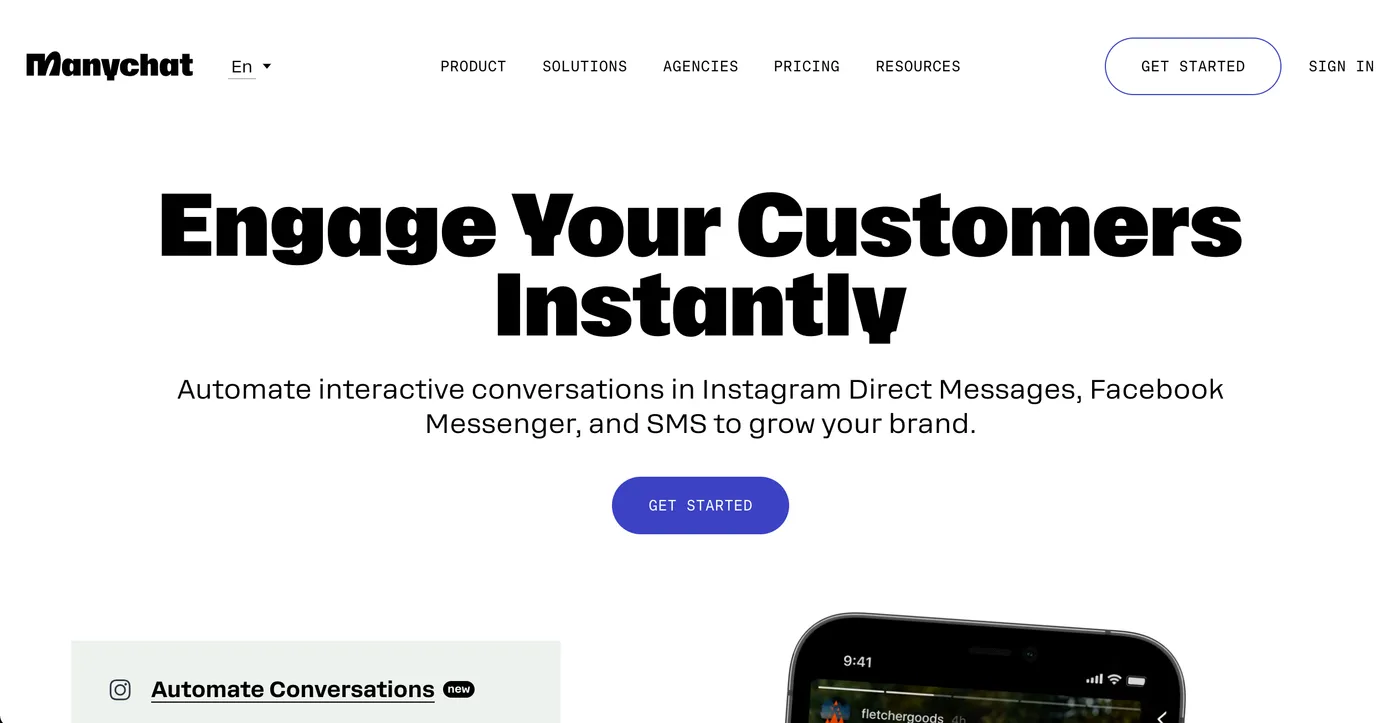
Main ManyChat features:
- Custom chatbots: conversation flows tailored to the business, built with text blocks, buttons, images, and interactive elements.
- Automatic responses: customers get an immediate reply even outside business hours, improving experience and engagement.
- Lead segmentation: targeted messages by behavior, interaction, and customer profile, increasing the relevance of communications.
- Scheduling of sends: messages scheduled for strategic times during marketing campaigns.
- Integrations: connection with email marketing platforms, CRM, and other tools, syncing data between systems.
- Data analysis: detailed metrics on chatbot and campaign performance to identify improvement opportunities.
- Multi-language support: a viable option for companies with a global presence or international audiences.
BotConversa: no-code chatbot for WhatsApp
BotConversa is a Brazilian tool that lets you build no-code chatbots for WhatsApp, automating marketing, lead generation, and customer service. The drag-and-drop builder assembles smart conversations, and the platform advertises integration with more than 3,000 apps, a control panel, its own CRM, link campaigns and QR code, and multiple agents on the same number.
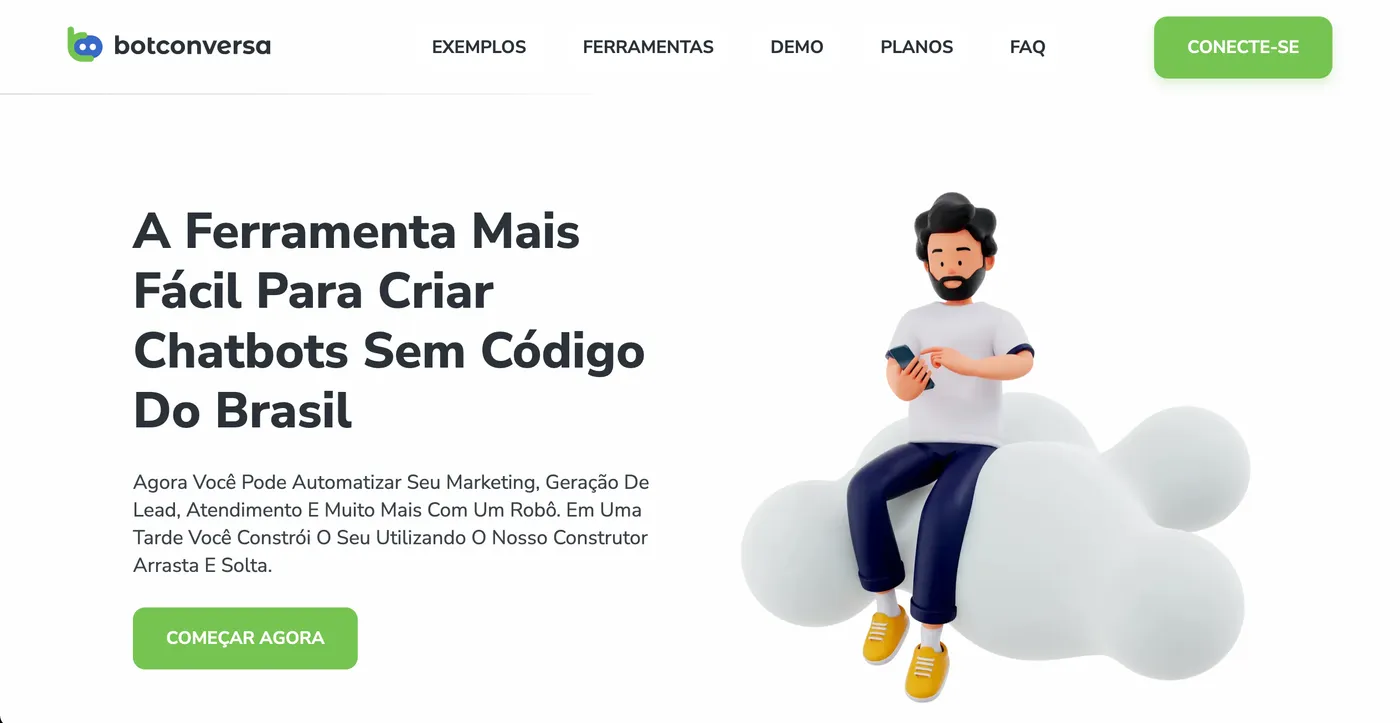
BotConversa maintains an active profile on Reclame Aqui, with a public history of answered complaints — a good thermometer to evaluate Brazilian vendors before hiring. For businesses whose dominant sales channel is WhatsApp, the combination of a visual builder, integrated CRM, and multi-user service makes it the most direct starting point on this list.
ConvertoBot: AI chatbots for websites and social networks
ConvertoBot is a chatbot platform that uses AI and natural language processing to build no-code bots, compatible with websites, Facebook Messenger, and WhatsApp. The proposal is to automate lead generation, sales, and bookings with fast setup: the platform offers a drag-and-drop builder and more than 100 ready-to-edit chatbot templates.
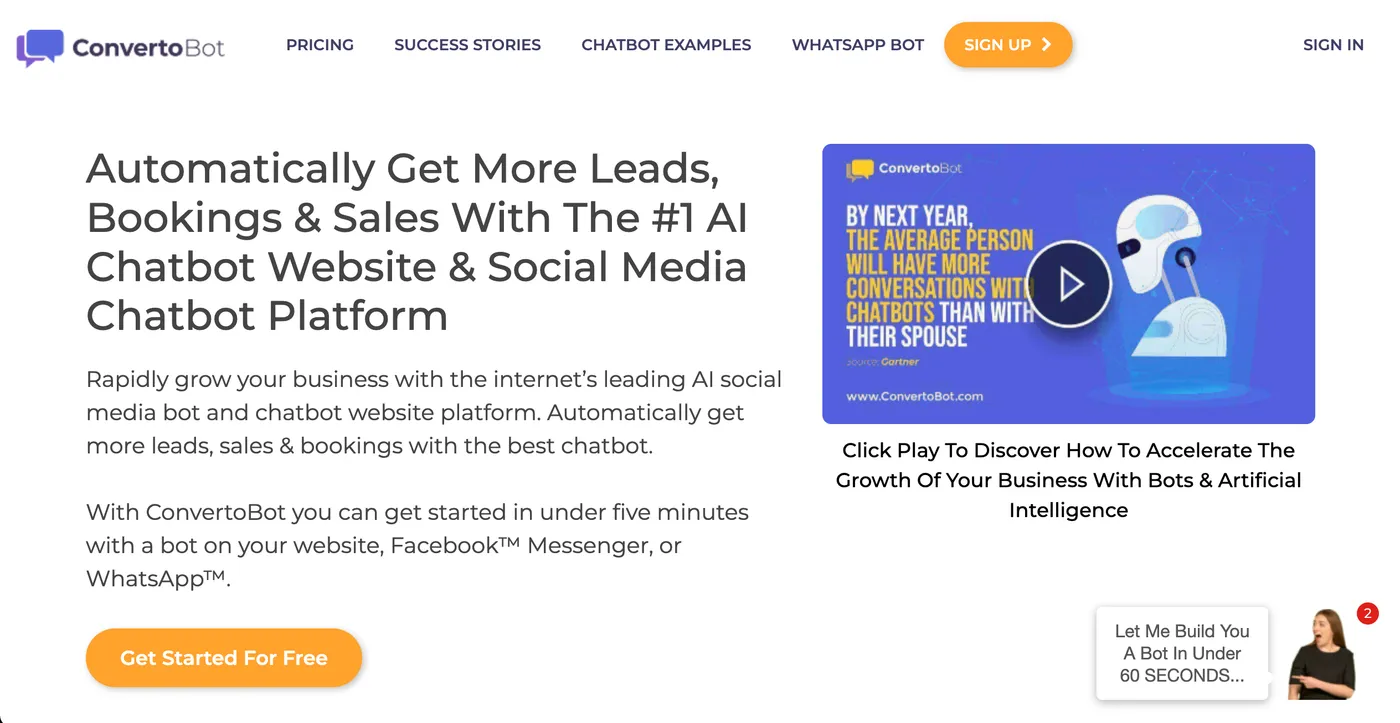
Main ConvertoBot features:
- Fast loading speed, so it does not harm the visitor experience.
- Customizable design, with visual flexibility to match the site''s identity.
- Variety of formats: site widget, exit-intent popup, and floating button.
- Multi-site license available on all plans.
- Advanced plans with ConvertoBot branding removal and assisted custom chatbot building.
ConvertoBot is accessible to all experience levels: no programming knowledge is needed to publish a working bot, and the enterprise plan adds unlimited sub-users and dedicated support.
ActiveCampaign: marketing automation with integrated CRM
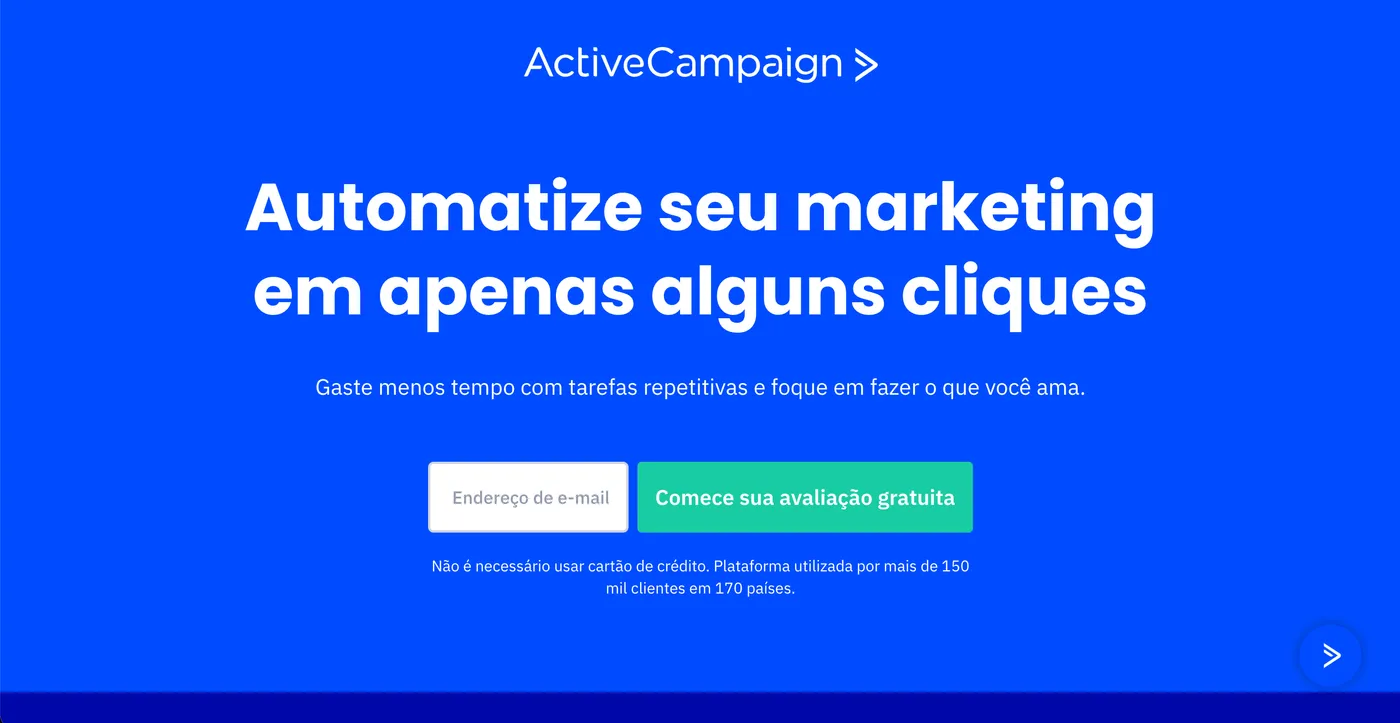
ActiveCampaign is a marketing automation and CRM platform that lets you build highly personalized campaigns, segment customers, and track engagement across the entire buyer journey. Among the four tools on this list, it is the most complete for orchestrating email marketing, sales, and service in one place.
Main ActiveCampaign features:
- Marketing automation: customer behavior-based workflows, with automatic email sending, segmentation, and lead scoring throughout the sales funnel.
- Personalized emails: relevant, targeted content for each segment, increasing open rates and engagement.
- Integrated CRM: management of leads, contacts, and opportunities with a detailed history of every interaction.
- Advanced segmentation: splitting the base by demographic, behavioral, and engagement data.
- Site personalization: site content adapted to each visitor''s actions and interests.
- Integrations: connection with WordPress, Shopify, Zapier, and other tools in the marketing ecosystem.
- Reports and analytics: detailed campaign performance metrics for informed decisions.
How to choose the right tool for your business?
Choosing the right automation tool depends on mapping needs, priority channels, and budget before looking at features. A powerful tool on the wrong channel generates cost without return — that is why the decision process matters more than the feature list. Follow the steps below:
- Identify your needs: analyze which areas of the business benefit most from automation — marketing, sales, or customer service.
- Research the available options: compare features, prices, support, and integrations of the candidate tools.
- Evaluate usability: prefer friendly, intuitive interfaces that accelerate adoption by the whole team.
- Check scalability: choose a tool that grows with the company and avoids frequent switches.
- Check integrations: ensure compatibility with the platforms you already use, easing data flow.
- Test before hiring: take advantage of free trial periods to validate the tool in your real operation.
- Assess cost and reputation: weigh the price against the expected return and check reviews from other users and the stability of the vendor company.
How to implement automation successfully?
A successful implementation of automation tools starts with clear goals and ends with continuous measurement of results. Companies that skip planning tend to automate the wrong processes and frustrate customers with generic flows. The roadmap below organizes the rollout:
- Define clear goals: establish what the automation should achieve — increase sales, improve service, or nurture leads.
- Plan the customer journey: map the touchpoints where automation improves the experience, from prospecting to after-sales.
- Segment your lead base: group contacts by behavior, interests, and purchase history for targeted messages.
- Create relevant content: develop personalized messages for each stage of the journey, offering value and solving problems.
- Test and adjust: run A/B tests on automated campaigns and refine the flows based on results.
- Train your team: enable employees to operate the tools and align the correct use of the technology.
- Monitor results: track performance metrics regularly to inform strategic decisions.
- Assess ROI: calculate the return on investment to ensure benefits exceed costs.
Those who want to understand the broader context of these technologies can explore the applications of Artificial Intelligence across sectors — automated service is just one of the expanding fronts.
Conclusion
Chatbots and automation have stopped being a differentiator and become a competitive requirement: with Gartner projecting bots as the primary service channel for a quarter of organizations by 2027, delaying adoption means handing leads to the competitor that answers in seconds. CodeCrush''s practical recommendation is to start small — a WhatsApp flow on BotConversa or an Instagram flow on ManyChat answering your business''s five most frequent questions — and only then evolve to complete journeys with CRM and email marketing on ActiveCampaign. Good automation is the one the customer does not even notice: fast, contextual, and with human handoff at the right moment.
Recommended for this topic
Picked by the editors — only what we would use.
Bookcenter RJ
Kit Upgrade INTEL I5 4570 + Placa Intel H81 + Memória 8 GB+ Cooler
MultGo Oficial
Hub USB 3.0 Tipo C Adaptador 4 em 1 Premium Alta Velocidade de Transmissão
XQW - ELETRÔNICOS E VARIEDADES
Carregador Portátil Mini Power Bank 10000mAh Com 02 Saídas Tipo-C / Lightning
## faq
Frequently asked questions
What is an automation chatbot for?
An automation chatbot automatically answers customers on channels like WhatsApp, Instagram, and websites, 24 hours a day. It qualifies leads, schedules sends, answers frequently asked questions, and syncs data with CRM and email marketing, freeing the sales team for strategic tasks like closing deals and personalized service.
ManyChat or BotConversa: which to choose?
Choose BotConversa if your main channel is WhatsApp and you want a Brazilian tool with integrated CRM and multiple agents on the same number. Prefer ManyChat if the operation depends on Instagram and Facebook Messenger, with lead segmentation and integrations with email marketing platforms.
Do I need to know how to program to create a chatbot?
No. The four tools in this article — ManyChat, BotConversa, ConvertoBot, and ActiveCampaign — offer drag-and-drop visual builders, with ready-made templates to customize. Technical knowledge helps with advanced API integrations, but anyone can publish a working conversation flow in a few hours.
Does a chatbot replace human service?
Not entirely. The chatbot resolves frequent questions and repetitive tasks instantly, but complex cases still require human agents. According to Gartner, chatbots will be the main service channel for about a quarter of organizations by 2027 — the winning model combines automation with handoff to people.
What is the difference between a chatbot and marketing automation?
The chatbot talks to the customer in real time on messaging channels, answering questions and qualifying leads. Marketing automation orchestrates complete journeys: emails, segmentation, lead scoring, and scheduled campaigns. Tools like ActiveCampaign unite the two worlds in a single platform with integrated CRM.
Topics in this article
## continue lendo
Artigos relacionados


Keep browsing
Previous article

Data Science: 65 Application Areas with Real Examples
Data science uses statistics and machine learning to drive decisions: see 65 application areas, from finance and health to smart cities.
Read moreNext article

5 Sites to Learn CSS by Playing: Flexbox and Grid
Flexbox Froggy, Flexbox Zombies, Grid Garden, Flexbox Defense and Grid Critters teach CSS Flexbox and Grid with interactive browser games.
Read moreAbout the author