- Published on
- · July 10, 2026
Machine Learning: what it is, how it works, and its uses
- Blog

- Henrico Piubello
- Henrico Piubello
- IT Specialist - Grupo Voitto
IT Specialist - Grupo Voitto

Machine Learning (machine learning) is the subfield of AI (Artificial Intelligence) that creates algorithms capable of learning patterns from data and improving with experience. In practice, it is the technology behind voice recognition, fraud detection and product recommendations.
- What is Machine Learning?
- How does Machine Learning work?
- What are the main Machine Learning algorithms?
- Why is Machine Learning important?
- Where is Machine Learning used in everyday life?
- How to start studying Machine Learning?
- Sectors that use Machine Learning
- Curiosities about Machine Learning
What is Machine Learning?
Machine Learning is a subset of artificial intelligence dedicated to creating algorithms and systems that learn and improve from data, without being explicitly programmed for each situation. The term was coined in 1959 by Arthur Samuel, a pioneering researcher whose definition IBM still records today as a reference in the field.
The goal of Machine Learning is to allow machines to learn from previous experiences: they are trained on a dataset and use what they learned to make predictions or decisions when facing new data.
This capability makes it possible to perform tasks that would normally require human intelligence, such as voice recognition, image recognition and language translation. There are three main types of learning: supervised (with labeled data), unsupervised (patterns in data without labels) and reinforcement (trial and error with rewards).
How does Machine Learning work?
Machine Learning works through algorithms that find patterns in data. During training, the algorithm analyzes examples and adjusts its internal parameters to associate features with the correct labels; once trained, it generalizes these patterns to predict, classify or decide about data it has never seen.
In detail, the process uses training and testing datasets: the training part teaches the model, and the testing part evaluates whether it gets it right on unseen data. This separation is essential to avoid overfitting, when the model memorizes the examples instead of learning the general pattern.
This ability to generalize allows applying Machine Learning to scenarios far beyond the original data, from image recognition to natural language processing. The value extracted from big data, however, goes beyond the algorithm: it depends on data management and quality, exploration and visualization tools, automated model comparison and reliable production deployment.
What are the main Machine Learning algorithms?
The most used algorithms in Machine Learning include linear regression, decision trees, random forests, neural networks, support vector machines and k-means. The choice depends on the task: predicting values, classifying categories or grouping similar data.
| Algorithm | Type | Typical use |
|---|---|---|
| Linear regression | Supervised | Predict continuous values, such as sales |
| Decision trees | Supervised | Classify with interpretable rules |
| Random forests | Supervised | Combine trees for higher accuracy |
| Neural networks | Supervised | Recognize voice, images and text |
| Support vector machines | Supervised | Separate classes with hyperplanes |
| K-means | Unsupervised | Group customers or similar data |
| Bayesian networks | Supervised | Model probabilities and uncertainties |
Beyond these, ensemble techniques like boosting and bagging combine several weak models into a more robust one, and methods like PCA (Principal Component Analysis) reduce the dimensionality of large datasets before training. To differentiate these techniques from neighboring concepts, it is worth knowing the difference between data mining, Machine Learning and Deep Learning.
Why is Machine Learning important?
Machine Learning is important because it transforms the enormous volume of data generated by companies into actionable predictions: identifying market opportunities, personalizing products, optimizing processes and mitigating risks such as fraud and operational failures.
Three factors drove this relevance: the growth in the volume and variety of data (transactions, social networks, sensors), the cheaper cost of computational processing and accessible cloud storage, which allows keeping and reusing data to train models.
The numbers confirm the movement. According to the Octoverse 2024 report from GitHub, "In 2024, Python overtook JavaScript as the most popular language on GitHub" — Python overtook JavaScript as the most popular language on the platform, driven precisely by AI and data science; the use of Jupyter Notebooks grew 92% in the same period. The Stack Overflow Developer Survey 2025 shows that 84% of developers use or plan to use AI tools at work, up from the 76% recorded in 2024.
For organizations, accurate models mean faster decisions: anticipating demand, detecting anomalies in real time and personalizing each customer's experience at scale.
Where is Machine Learning used in everyday life?
Machine Learning is present in five major everyday applications:
- Voice recognition — virtual assistants like Siri, Alexa and Google Assistant
- Image recognition — facial recognition and security cameras
- Sales forecasting — inventory planning and retail targets
- Fraud detection — blocking suspicious transactions in banks
- Product recommendations — personalized suggestions in e-commerce
Voice recognition
Voice recognition uses algorithms trained with large volumes of audio and their transcriptions to convert speech into text. During training, the model learns to recognize phonemes and speech patterns and to correlate sounds with written words — the more data, the better the transcription.
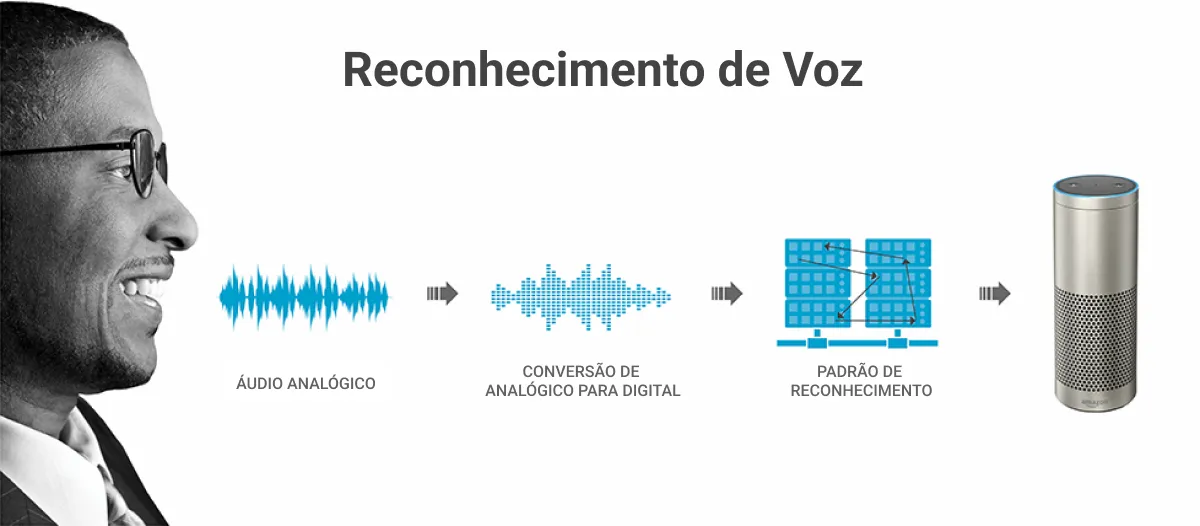
The virtual assistants Siri, Alexa and Google Assistant are the most popular examples: they receive voice commands, convert them into text and execute the corresponding action, combining voice recognition with natural language processing for more natural responses.
Image recognition
Image recognition trains systems to identify and classify objects in photos and videos. The algorithms receive sets of labeled images and learn the visual patterns associated with each category, generally with CNNs (convolutional neural networks), which capture everything from lines and basic shapes to abstract features.
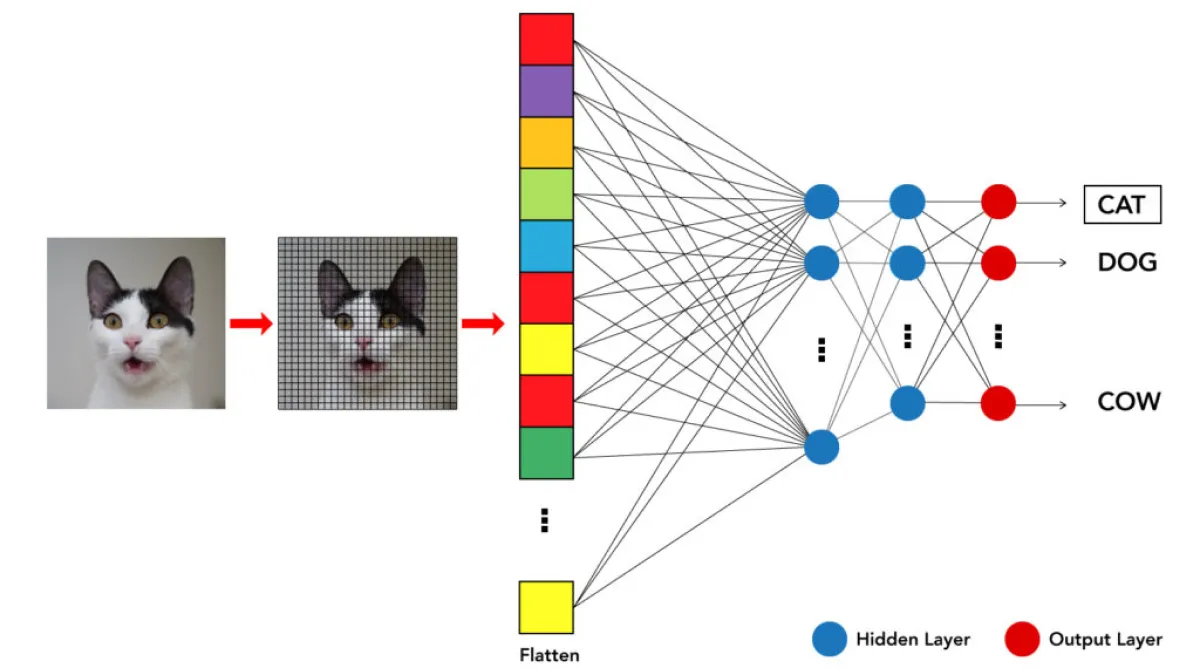
Practical applications include facial recognition for authentication, surveillance cameras that detect suspicious activity and systems that identify people, vehicles or objects of interest in real time.
Sales forecasting
Sales forecasting analyzes sales history, seasonality, market trends and promotional campaigns to project future demand. Linear regression and time series models are the starting point; decision trees, random forests and neural networks refine the accuracy.
With reliable forecasts, companies plan inventory, set targets, allocate resources and adjust marketing strategies as the market changes — reducing costs and maximizing profit opportunities.
Fraud detection
Fraud detection trains algorithms with examples of legitimate and fraudulent transactions to identify, in real time, suspicious patterns such as unauthorized transactions or money laundering. Upon detecting an anomaly, the system triggers alerts or blocks the operation for analysis.
Banks and financial institutions use these systems at scale, and the models improve continuously as new examples of fraud enter the training set.
Product recommendations
Product recommendations analyze purchase history, browsing, ratings and preferences to suggest relevant items — the mechanism used by e-commerce giants like Amazon. If a customer bought a book, the system suggests titles by the same author or genre, updating the suggestions with each new piece of data.
For companies, recommendations increase conversion, engagement and loyalty; the algorithms can be calibrated to balance popularity, inventory and profit margin.

How to start studying Machine Learning?
To start studying Machine Learning from scratch, follow four steps in order — from the programming foundation to practical projects. Here at CodeCrush we also keep a complete guide of methods and resources to study Machine Learning.
- Learn the programming fundamentals: master a popular language in the field, such as Python, including variables, control structures, functions and data manipulation.
- Study mathematics and statistics: build a solid foundation in linear algebra, differential calculus and statistics — vectors, matrices, derivatives, probabilities and distributions.
- Explore the fundamental concepts: understand supervised, unsupervised and reinforcement learning, and practice algorithms such as linear regression, decision trees, k-means and neural networks.
- Practice with real projects and data: develop your own projects and participate in data science competitions on Kaggle to learn from other professionals.
Stay up to date with the official documentation of the libraries (scikit-learn, TensorFlow, PyTorch) and with learning communities: the field evolves fast, and constant practice is what consolidates the theory.
Sectors that use Machine Learning
Machine Learning is now adopted in practically every sector of the economy. The highlights are:
- Financial services — identifying insights in market data and preventing fraud, supporting safer investment decisions.
- Government — analysis of multiple data sources for operational efficiency, resource savings and combating identity theft.
- Healthcare — wearable devices and connected sensors provide real-time data for more accurate diagnoses and personalized treatments.
- Marketing and sales — analysis of purchase history and personalized recommendations that increase campaign relevance and customer loyalty.
- Oil and gas — mineral analysis, sensor failure prediction and energy distribution optimization.
- Transportation — more efficient routes and prediction of potential problems to increase profitability and improve the user experience.
This cross-cutting demand explains why companies look for data scientists, Machine Learning engineers and AI specialists with advanced technical skills and practical experience with large volumes of data.
Curiosities about Machine Learning
- The This Waifu Does Not Exist project uses generative neural networks to create entirely fictional anime characters — each time the page is refreshed, a new image is generated.
- AlphaGo, a program by Google DeepMind, beat Go world champion Lee Sedol 4 to 1 in March 2016, demonstrating that Machine Learning algorithms can surpass humans in domains of extremely high complexity.
- In machine learning, the target the model tries to predict is called a label.
- The Japanese company SoftBank developed the robot Pepper, which uses Machine Learning algorithms to recognize emotions and respond to facial expressions and body language.
Conclusion
Machine Learning has gone from being a differentiator to becoming infrastructure: anyone who works with technology will bump into it, whether consuming a model via API or building their own. The good news is that the entry door has never been so accessible — Python, basic statistics and practical projects on Kaggle already put you in the game. Start small, understand the fundamentals before the trendy tools and let the data guide your decisions: that is exactly the mindset the market is looking for.
Recommended for this topic
Picked by the editors — only what we would use.
Bookcenter RJ
Kit Upgrade INTEL I5 4570 + Placa Intel H81 + Memória 8 GB+ Cooler
A Casa dos Importados
Hub Usb 2.0 c/7 Portas Pen Drive Teclado 480mbps Hd
MultGo Oficial
Hub USB 3.0 Tipo C Adaptador 4 em 1 Premium Alta Velocidade de Transmissão
## faq
Frequently asked questions
What is Machine Learning for?
Machine Learning is used to automate tasks that would require human intelligence: recognize voice and images, forecast sales, detect financial fraud and recommend products. Companies use models trained on historical data to make faster and more accurate decisions in sectors such as finance, healthcare, retail, transportation and energy, reducing costs and anticipating risks.
What is the difference between Machine Learning and Artificial Intelligence?
Artificial Intelligence is the broad field that seeks to create systems capable of simulating human intelligence. Machine Learning is a subfield of AI focused on algorithms that learn patterns from data. All Machine Learning is AI, but not all AI uses Machine Learning: rule-based systems are also AI.
What are the three types of machine learning?
There are three main types: supervised learning, which trains with labeled data to predict or classify; unsupervised learning, which finds patterns and clusters in data without labels; and reinforcement learning, in which the algorithm learns by trial and error receiving rewards, as in systems that play chess or Go.
Which language to use for Machine Learning?
Python is the most used language in Machine Learning thanks to libraries like scikit-learn, TensorFlow and PyTorch. According to the GitHub Octoverse 2024 report, Python became the most used language on the platform, driven by AI and data science. The R language is also common in statistical analysis and academic research.
Is it worth learning Machine Learning in 2026?
Yes. AI adoption continues to accelerate: 84% of developers use or plan to use AI tools, according to the Stack Overflow Developer Survey 2025. Companies in every sector are looking for data scientists and Machine Learning engineers, and demand for these professionals remains higher than the qualified supply.
Topics in this article
## continue lendo
Artigos relacionados



Keep browsing
Previous article

What is Python? A beginner's guide with examples
Python is a high-level, interpreted and multiparadigm language, used in data science, AI, automation and web. See examples and how to start.
Read moreNext article

How to Choose a Notebook: A Guide to Processor, RAM, and SSD
To choose a notebook, define the use: basic tasks need a Core i3 or Ryzen 3, 8 GB of RAM, and an SSD; heavy work needs an i5/i7 and 16 GB.
Read moreAbout the author