- Published on
- · July 10, 2026
Machine Learning vs Artificial Intelligence: the difference
- Blog

- Renata Weber
- Renata Weber
- Growth Specialist at Pareto Plus
Growth Specialist at Pareto Plus
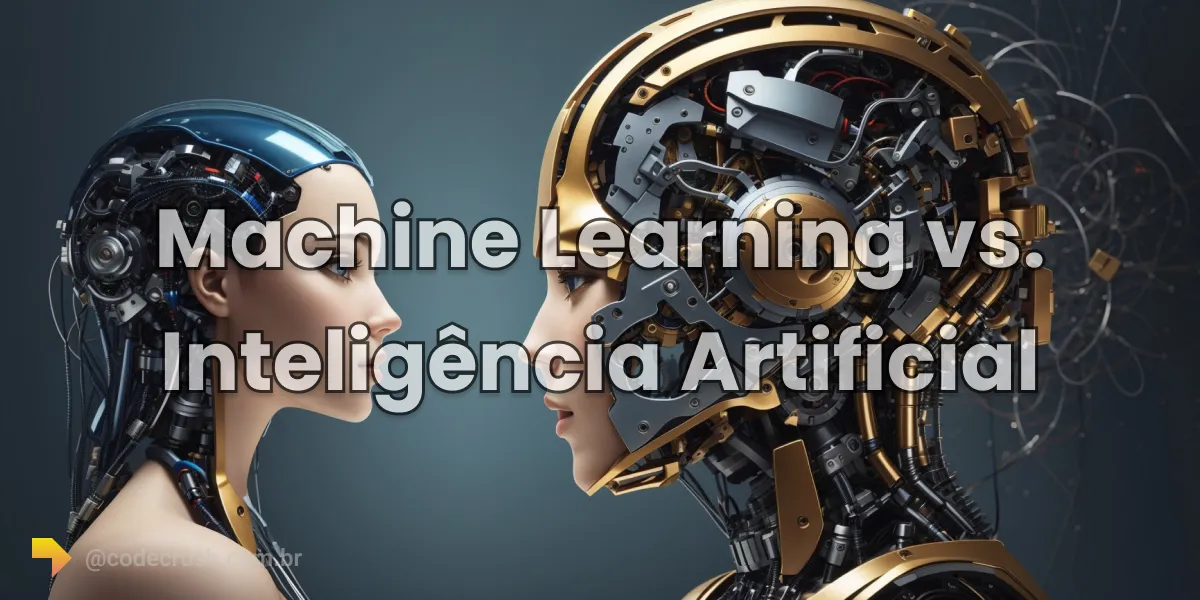
Artificial Intelligence (AI) is the field of computing that creates systems capable of performing tasks that would require human intelligence. Machine Learning is a subarea of AI in which algorithms learn patterns from data. All Machine Learning is AI; the reverse is not true.
- What is the difference between Machine Learning and Artificial Intelligence?
- What is Artificial Intelligence?
- What is Machine Learning?
- How does Machine Learning work in practice?
- The future of AI and Machine Learning
- Conclusion
What is the difference between Machine Learning and Artificial Intelligence?
The difference between Machine Learning and Artificial Intelligence is one of scope: AI is the umbrella that gathers all techniques to create systems with intelligent behavior, while Machine Learning is the specific approach in which the computer learns rules from examples, instead of receiving them ready-made from a programmer. The confusion is common because, today, most AI systems in production use Machine Learning as their engine.
| Aspect | Artificial Intelligence | Machine Learning |
|---|---|---|
| Scope | Broad field that simulates human capabilities | Subarea of AI focused on learning |
| Goal | Solve problems as a human would | Learn patterns from data |
| How it works | Rules, logic, search, and learning | Training models with examples |
| Origin of the term | John McCarthy, 1955 | Arthur Samuel, 1959 |
| Examples | Virtual assistants, autonomous cars | Recommendation, fraud detection, forecasting |
The relationship is one of set and subset: an expert system based on fixed rules is AI without being Machine Learning, while a Netflix recommendation model is Machine Learning and therefore also AI. One level down in this hierarchy appears Deep Learning — if you want to understand this layer, see the differences between data mining, Machine Learning, and Deep Learning.
What is Artificial Intelligence?
Artificial Intelligence is the area of computer science dedicated to building systems that solve problems in a way analogous to human reasoning: they analyze data, identify patterns and trends, and use those conclusions to make decisions. John McCarthy, who coined the term in 1955, defined the area as "the science and engineering of making intelligent machines" in the article What is Artificial Intelligence? (Stanford).
It is important to note that this is a simplified explanation: an intelligent system does not necessarily have to resemble human reasoning. McCarthy himself emphasized that AI is not confined to biologically observable methods. What matters is the result — perceiving the environment, processing information, and acting to achieve a goal.

Artificial Intelligence covers varied techniques: rule systems, search algorithms, logical planning, and, of course, machine learning. In practice, these techniques already support everything from medical diagnoses to voice assistants — a panorama we explore in applications of Artificial Intelligence across sectors.
What is Machine Learning?
Machine Learning is the subarea of Artificial Intelligence that enables machines to learn from data, improving performance on a task as they accumulate experience — without each rule being manually programmed. The term was coined in 1959 by Arthur Samuel, a researcher at IBM who created one of the first programs capable of learning by playing checkers.
The parallel with human learning helps: the more we perform a task, the more skilled we become at it. Something similar happens in Machine Learning systems — algorithms are trained on publicly available data or data recorded on proprietary platforms, and those examples serve as the basis for the model to generalize decisions about new cases.
As for the training itself, there are several approaches and families of algorithms: supervised, unsupervised, and reinforcement learning, with techniques ranging from linear regression to neural networks. The choice depends on the specific application and the available data. To go deeper, see the meaning and importance of Machine Learning.
How does Machine Learning work in practice?
Machine Learning works in a three-step cycle: collect and prepare data, train a model with those examples, and evaluate the predictions on data the model has never seen. It is in this training stage that Machine Learning becomes the central piece of most modern AI systems — the quality of the data determines the quality of the decisions.
Although Artificial Intelligence aims to reproduce human capabilities in a broad sense, Machine Learning tackles a more delimited problem: turning historical examples into statistical decision rules. Those who want to follow this path will find a complete roadmap in the guide to studying Machine Learning, with methods and resources.
Watch this video for a more visual understanding of the relationship between Artificial Intelligence and Machine Learning, with practical examples.
The future of AI and Machine Learning
The adoption of AI and Machine Learning is growing at an accelerated pace. According to the McKinsey The State of AI report (November 2025), 88% of organizations already use AI in at least one business function, up from 78% the previous year. Among developers, the Stack Overflow Developer Survey 2025 shows that 84% use or plan to use AI tools at work — although 46% say they do not trust the accuracy of the answers, which reinforces the importance of understanding how these models work.
Some trends concentrate the investments:
- Conversational AI: virtual assistants evolve to hold natural dialogues and understand complex contexts, far beyond simple commands.
- AI in Healthcare: Machine Learning algorithms analyze medical images and support diagnoses, paving the way for personalized treatments.
- Autonomous Cars: vehicles use AI for navigation and real-time decision-making, with the automotive industry investing heavily in the technology.
- Explainable AI: the lack of transparency in models pressures researchers to create systems whose decisions can be audited and understood.
- Ethics and Regulation: algorithmic bias and privacy demand stricter regulations and solid ethical standards for the responsible use of AI.
The impact on work is also real: as AI automates routine tasks, new opportunities emerge linked to maintaining intelligent systems, engineering, and data analysis.
Conclusion
Machine Learning and Artificial Intelligence do not compete with each other: the first is the statistical engine that today drives the second. For those working in technology, the practical lesson is to master the hierarchy — AI as the field, Machine Learning as the method, data as the raw material — because it is what separates those who merely use tools from those who can evaluate and build them. Here at CodeCrush, the recommendation is direct: start with the fundamentals of data and statistics before rushing to the framework of the moment; the concept ages much more slowly than the tool.
Recommended for this topic
Picked by the editors — only what we would use.
MultGo Oficial
Hub USB 3.0 Tipo C Adaptador 4 em 1 Premium Alta Velocidade de Transmissão
A Casa dos Importados
Hub Usb 2.0 c/7 Portas Pen Drive Teclado 480mbps Hd
Bookcenter RJ
Kit Upgrade INTEL I5 4570 + Placa Intel H81 + Memória 8 GB+ Cooler
## faq
Frequently asked questions
Are Machine Learning and Artificial Intelligence the same thing?
No. Artificial Intelligence is the broad field that seeks to create systems capable of performing tasks that would require human intelligence. Machine Learning is a subarea of AI in which algorithms learn patterns from data. All Machine Learning is AI, but there are AI systems that do not use machine learning.
Does every Artificial Intelligence system use Machine Learning?
No. Expert systems based on fixed rules, heuristic search engines, and logical planners are also Artificial Intelligence and do not learn from data. Machine Learning is the dominant approach today because it scales better, but it is only one of the possible paths to building a system considered intelligent.
What is the difference between Machine Learning and Deep Learning?
Deep Learning is a subarea of Machine Learning that uses artificial neural networks with many layers to learn complex representations, like images, audio, and text. All Deep Learning is Machine Learning, but classic techniques like decision trees and linear regression are not Deep Learning.
Is it worth learning Machine Learning in 2026?
Yes. According to the Stack Overflow Developer Survey 2025, 84% of developers use or plan to use AI tools at work, and companies in every sector look for professionals who understand models, data, and their limits. Fundamentals of statistics, Python, and data engineering remain the best entry point.
Where to start studying Machine Learning?
Start with the fundamentals: programming logic, Python, statistics, and linear algebra. Then practice with libraries like scikit-learn and public datasets, building small classification and regression projects. Studying theory in parallel with hands-on projects accelerates learning and builds a portfolio for the market.
Topics in this article
## continue lendo
Artigos relacionados



Keep browsing
Previous article

Gatekeeper and UBA: User Behavior Analytics
UBA monitors user behavior to detect anomalies; integrated with Gatekeeper, it exposes internal threats that authentication alone cannot see.
Read moreNext article

How to Create Machine Learning Projects: A 5-Step Guide
Machine learning projects require data preparation, suitable algorithms, iterative pipelines, scalability, and metrics like recall and F1-Score.
Read moreAbout the author