- Published on
- · July 10, 2026
Network Communication: Protocols, the OSI Model, and TCP/IP
- Blog

- Henrico Piubello
- Henrico Piubello
- IT Specialist - Grupo Voitto
IT Specialist - Grupo Voitto
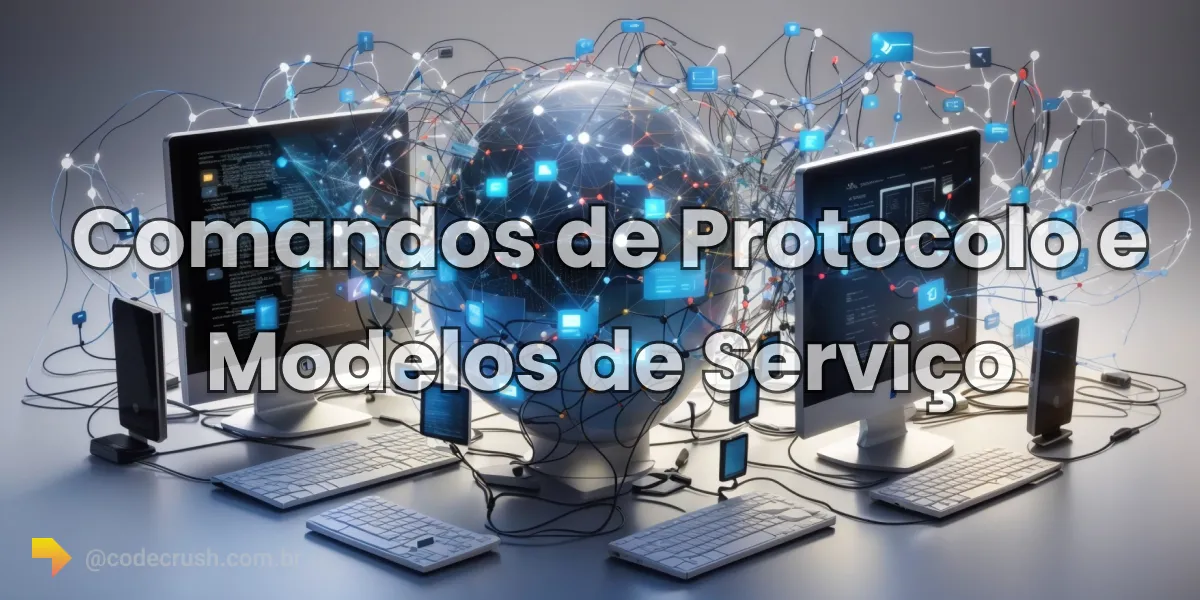
Network communication is the exchange of data between devices through protocols — rules that define how information is transmitted, addressed, and received. The OSI Model organizes this process into seven conceptual layers, while the TCP/IP stack implements it in practice across the entire internet.
- What is network communication?
- What is the OSI Model?
- What are the 7 layers of the OSI Model?
- Messages, segments, datagrams, and frames
- How do the TCP/IP protocols work?
- What is the difference between TCP and UDP?
- What are protocol service models?
- Service models in practice
- Challenges and the future of network communication
What is network communication?
Network communication is the ability of computers, smartphones, servers, and sensors to share information, data, and resources through wired or wireless connections. At the center of this process are communication protocols: sets of rules that determine how data is divided, transmitted, received, and interpreted by every participating device.
Imagine the internet as a tangle of digital roads where data travels at high speeds, connecting billions of devices. This infrastructure is what lets you send emails, watch videos, join video calls, and share files — and the performance of each of those activities depends directly on the delay and latency of packets on the network.
Efficient network communication underpins entire spheres of society: in business, it enables real-time collaboration between distributed teams; in medicine, it enables telemedicine and exam sharing; in education, it makes distance learning possible; in entertainment, it powers streaming and online gaming at global scale.
What is the OSI Model?
The OSI Model (Open Systems Interconnection) is a reference model that describes how the protocol layers of a network should interact to enable communication between heterogeneous systems. The model was developed by the International Organization for Standardization (ISO) and published as the ISO/IEC 7498-1 standard, whose current revision dates from 1994.
The OSI Model's great contribution is its layered architecture: each layer has well-defined functions and responsibilities and talks only to the neighboring layers. This division brings modularity, flexibility, and ease of maintenance — one layer can be replaced or updated without affecting the others — and ensures interoperability between equipment from different vendors, as long as they follow the same protocols.
What are the 7 layers of the OSI Model?
The seven layers of the OSI Model are: Physical, Data Link, Network, Transport, Session, Presentation, and Application. The table below summarizes the role of each, from the closest to the hardware to the closest to the user:
| Layer | Main function | Examples |
|---|---|---|
| 1. Physical | Transmits bits over the physical medium | Cables, switches, network cards |
| 2. Data Link | Delivers frames between adjacent nodes | Ethernet, MAC addresses |
| 3. Network | Routes packets between different networks | IP protocol, routers |
| 4. Transport | Ensures end-to-end data delivery | TCP, UDP |
| 5. Session | Opens, maintains, and closes sessions | RPC, session sockets |
| 6. Presentation | Translates, formats, and encrypts data | TLS, JPEG, ASCII |
| 7. Application | Interfaces with user programs | HTTP, FTP, SMTP |
At the Data Link layer operate MAC (Media Access Control) addresses, which physically identify each device on the local network, plus error detection and correction mechanisms. At the Network layer, IP (Internet Protocol) forwards packets and determines the best path to the destination. At the Transport layer, TCP (Transmission Control Protocol) and UDP (User Datagram Protocol) handle segmentation, flow control, and reordering of the data.
The Application layer is the most visible to developers: it's where the HTTP of the web, the FTP of file transfer, and the SMTP protocol, which moves the world's email, operate. The Session and Presentation layers are less implemented as separate blocks in modern stacks, which tend to absorb their functions into the application itself.
Messages, segments, datagrams, and frames
Data doesn't travel across the network all at once: it is divided and encapsulated into increasingly smaller units, layer by layer, in a process called encapsulation. Each unit receives headers with control information that allow everything to be reassembled at the destination. The full path has four stages:
- Message: the unit generated by the application — an email, a web page, a file. Messages are usually too large for a single send, especially on long-distance networks, and so need to be divided.
- Segment: the block created by the transport layer when it fragments the message. Each segment carries sequence numbers that let the receiver reassemble the data in the correct order.
- Datagram: the independent packet created by the network layer with the IP protocol. Datagrams can take different routes to the destination, working around congestion and link failures.
- Frame: the final unit of the link layer, with MAC addresses and error checking. Frames travel through switches and routers; at the destination, they are decapsulated until the original message is reconstructed.
How do the TCP/IP protocols work?
The TCP/IP protocols are the set of rules and standards that govern device communication on the internet and local networks. TCP (Transmission Control Protocol), specified by the IETF (Internet Engineering Task Force) in RFC 9293, published in 2022, controls the reliable delivery of data; IP (Internet Protocol), defined by RFC 791 since 1981, addresses and routes the packets.
The operation follows five steps:
- Packet division: the data to be transmitted is fragmented into small packets to ease transport across the network.
- Addressing: each packet receives IP addresses that identify the source and destination.
- Routing: the packets cross routers that calculate the best path to the destination.
- Reassembly: at the destination, the packets are reordered to reconstruct the original data.
- Error control: TCP confirms receipt of each packet and requests retransmission of any that were lost.
TCP/IP also depends on supporting services to work at scale: it's the distributed structure of DNS (Domain Name System) that translates human-readable domain names into routable IP addresses.
What is the difference between TCP and UDP?
TCP ensures reliable, ordered delivery of data through a prior connection, acknowledgments, and retransmissions; UDP, defined by RFC 768 (1980), sends packets without a connection or guarantees, in exchange for minimal latency. The choice depends on what the application can afford to lose: time or packets.
| Feature | TCP | UDP |
|---|---|---|
| Connection | Connection-oriented (handshake) | No prior connection |
| Reliability | Guarantees delivery, retransmits loss | No delivery guarantee |
| Order | Reorders segments at the destination | Does not reorder packets |
| Latency | Higher, due to extra control | Minimal, immediate sending |
| Use cases | Web, email, files | Streaming, gaming, video calls |
What are protocol service models?
Protocol service models define what kind of guarantee the network offers applications: reliable delivery, speed, a maximum time, or simultaneous reach. Each protocol implements one of these models, and the right choice determines the efficiency and performance of the communication. The six most common models are:
Best-Effort
The network makes its best effort to deliver the data, with no guarantee of delivery or order. UDP follows this model: it's simple and economical in resources, ideal for applications that tolerate losses, but unsuitable for those that require reliability.
Connection-Oriented
A connection is established before transfer, and the network guarantees reliable, ordered delivery. TCP is the classic example, suited to file transfer, email, and web browsing.
Streaming
The network prioritizes continuous real-time data flows and minimizes latency to keep playback smooth. RTP (Real-time Transport Protocol), standardized by RFC 3550, was designed for this model.
Reliability with Time Guarantee
The model combines reliable delivery with time limits, essential in industrial control systems, telemedicine, and mission-critical applications, where delays compromise the outcome.
Multicast
Data is transmitted to a specific group of receivers simultaneously, saving bandwidth — ideal for live broadcasts and video conferences with many participants.
Broadcast
Data is sent to every device on the local network, which is useful in scenarios like resource discovery and configuration updates.
Service models in practice
Service models show up in situations anyone lives daily. These examples show each model in action in the real world:
- Web browsing (TCP): when accessing a site, the browser opens a TCP connection with the server. If packets are lost, the protocol requests retransmission, and the page arrives intact even on unstable networks.
- Video conferencing (UDP): apps like Zoom transmit audio and video over UDP, prioritizing low latency. Lost packets cause small glitches, but the conversation flows in real time.
- Live streaming (RTP): live streams on YouTube and Twitch use streaming protocols like RTP, which favor quick delivery over perfection, accepting occasional losses.
- Subscription TV (IGMP): IGMP (Internet Group Management Protocol) lets devices subscribe to multicast groups and receive the same channel simultaneously, saving bandwidth.
- Telemedicine (DICOM): the DICOM (Digital Imaging and Communications in Medicine) standard transmits medical images with priority and integrity, meeting critical-time requirements.
- Device discovery (ARP): ARP (Address Resolution Protocol) sends a broadcast request to discover the MAC address of another device on the local network.
Challenges and the future of network communication
Networks face four central challenges: cybersecurity against increasingly sophisticated attacks; the explosive growth of data generated by IoT (Internet of Things) devices; the ultra-low-latency demands of applications like virtual reality; and traffic management with QoS (Quality of Service) and SDN (Software-Defined Networking).
Two numbers show the speed of this evolution. According to Google's official IPv6 statistics, the protocol surpassed 50% of access to the service in March 2026 — the first time it overtook IPv4, limited to about 4.3 billion addresses. Meanwhile, the Ericsson Mobility Report of November 2025 counts 2.9 billion 5G subscriptions at the end of 2025 and projects 6.4 billion by 2031.
The future points to edge networks (edge computing) that process data close to where it's generated, automation with artificial intelligence for self-management, network function virtualization (NFV) to scale services in the cloud, and growing use of blockchain technology to guarantee data integrity. The adoption of open standards will continue as the engine of interoperability and innovation in protocols and service models.
Conclusion
Understanding network communication has stopped being the exclusive concern of infrastructure administrators: every developer who debugs a slow API, configures a WebSocket, or optimizes streaming is dealing with OSI layers, TCP, UDP, and service models — whether they know it or not. Mastering these fundamentals is what separates those who merely use the network from those who can diagnose it, and here at CodeCrush the recommendation is direct: learn the path of the data, from message to frame, before blaming the server for the slowness.
Recommended for this topic
Picked by the editors — only what we would use.
Liss Fashion Variedades
Adaptador USB Wireless WI-FI Nano AC600 2.4ghz E 5ghz T2u TP LINK
Liss Fashion Variedades
Roteador Tecnologia Mesh Tp-Link Dual Band AX3000 Wi-Fi 6 EX520
IP Store Brasil
Adaptador Hrebos HUB AD203C LateralLink Tipo-C 4 Portas Conector Micro USB V8 Para PC E Laptop Receptor
## faq
Frequently asked questions
What is the OSI Model for?
The OSI Model serves as a conceptual reference for understanding and designing computer networks. It divides communication into seven independent layers, each with specific functions, which eases problem diagnosis, interoperability between vendors, and the evolution of one protocol without affecting the other layers of the stack.
TCP vs UDP: which to choose?
Choose TCP when reliable, ordered delivery of data is essential, as in web browsing, email, and file transfer. Choose UDP when low latency matters more than reliability, as in video calls, online gaming, and real-time streaming — scenarios that tolerate occasional packet loss.
What is the difference between the OSI Model and TCP/IP?
The OSI Model is a theoretical reference model with seven layers, created by the ISO to standardize networking concepts. TCP/IP is the protocol stack actually used on the internet, organized into four layers. In practice, engineers use OSI to teach and diagnose, and TCP/IP to implement.
What is data encapsulation in networks?
Encapsulation is the process where each network layer adds its own headers to the data. An application message becomes segments at the transport layer, datagrams at the network layer, and frames at the link layer, until it is transmitted as bits over the physical medium and decapsulated at the destination.
Is it worth studying computer networks in 2026?
Yes. Networks are the foundation of cloud computing, DevOps, security, and distributed systems. With IPv6 exceeding 50% of access to Google and 5G reaching 2.9 billion subscriptions, professionals who master protocols, latency, and routing remain among the most sought after in the technology market.
Topics in this article
## continue lendo
Artigos relacionados

Keep browsing
Previous article

What are Big Techs? Impact and dominance of the giants
Big Techs are technology giants like Google, Apple, Amazon, Microsoft and Meta that dominate the digital economy, data and innovation on a global scale.
Read moreNext article

What is a technologist? A guide to technology degrees
A technologist is the higher-education degree from the Higher Technology Courses: a practical 2 to 3 year program focused on a specific area of the market.
Read moreAbout the author