- Published on
- · July 10, 2026
Types of Frameworks: Web, Mobile, Data, and Games
- Blog

- Henrico Piubello
- Henrico Piubello
- IT Specialist - Grupo Voitto
IT Specialist - Grupo Voitto
The types of frameworks are divided by application domain: web, mobile, data science and machine learning, games, and the Internet of Things (IoT). Each category gathers ready-made structures and components that accelerate development in that field, from Next.js on the front-end to TensorFlow in artificial intelligence.
- What are the main types of frameworks?
- What are web development frameworks?
- What features do web frameworks offer?
- How do frameworks for mobile apps work?
- What are data science and machine learning frameworks?
- What are game and simulation frameworks for?
- How do frameworks support the Internet of Things (IoT)?
- Framework or library: what is the difference?
What are the main types of frameworks?
Frameworks are reusable code structures that provide architecture, features, and conventions to accelerate application creation. Instead of writing everything from scratch, the developer leverages ready-made patterns and focuses on the product's logic. They are organized into five major categories by domain of use:
- Web development frameworks — create sites and applications, such as Next.js, Django, and Laravel.
- Mobile frameworks — generate iOS and Android apps, such as Flutter and Ionic.
- Data science and machine learning frameworks — model and train data, such as TensorFlow and scikit-learn.
- Game and simulation frameworks — render graphics and physics, such as Unity and Unreal Engine.
- IoT frameworks — connect devices and sensors, such as Arduino.
The table below summarizes each category, its examples, and the main use case:
| Category | Examples | Main use case |
|---|---|---|
| Web | Next.js, Django, Laravel | Sites and web applications |
| Mobile | Flutter, Ionic | Apps for iOS and Android |
| Data and ML | TensorFlow, scikit-learn | Models and data analysis |
| Games | Unity, Unreal Engine | 2D, 3D games and virtual reality |
| IoT | Arduino | Connected devices and sensors |
What are web development frameworks?
Web development frameworks make it easier to create sites and applications, offering route management, database access, user authentication, and template generation. They are the most used technological base on the market: according to the Stack Overflow Developer Survey 2025, Node.js is the most used web technology among developers, with 48.7%, closely followed by React, with 44.7%.
The most popular web frameworks include Next.js, Django, Ruby on Rails, Laravel, and Bootstrap. Each serves a different language and project style.
Next.js
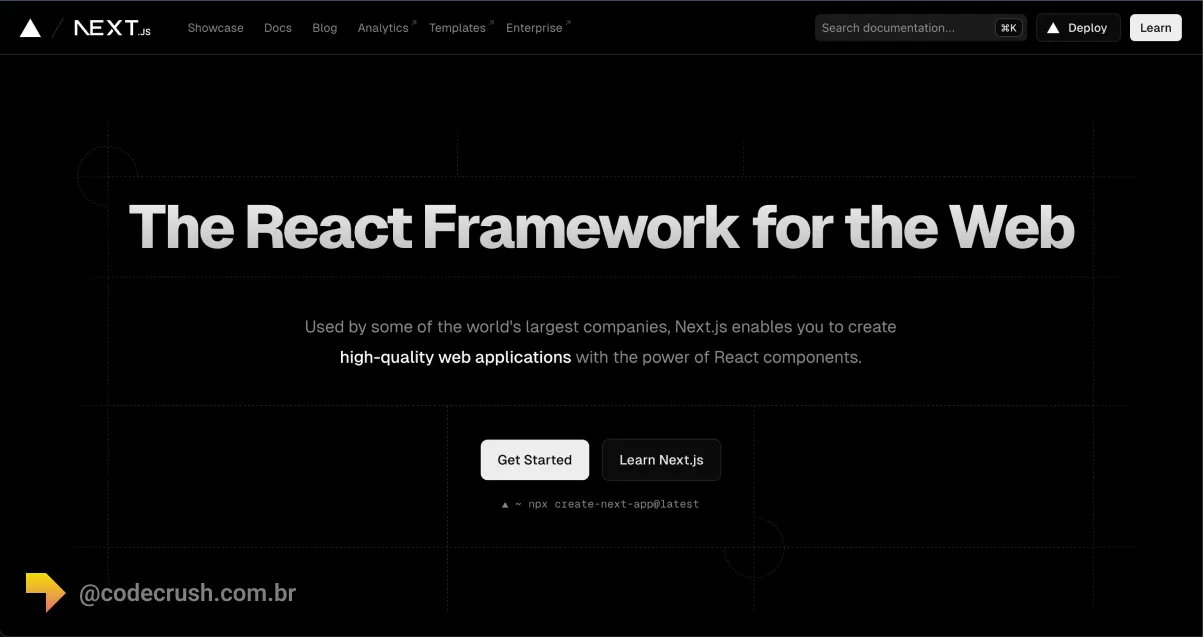
Next.js is a JavaScript web development framework, based on React, that allows building modern, scalable applications. It offers server-side and client-side rendering, enabling both static and dynamic pages.
With simple routing, optimized rendering, support for TypeScript, and integration with external APIs, Next.js delivers an agile experience. Its flexibility makes it popular in projects that require high performance and advanced SEO (Search Engine Optimization).
Django
Django is a high-level web framework written in Python that allows building complex applications quickly and efficiently. It adopts the MVC (Model-View-Controller) architectural pattern and brings ready-made features that reduce repetitive work.
With an integrated ORM (Object-Relational Mapping), automatic admin panel, and user authentication, Django makes robust and secure applications easy. Its emphasis on readability and code reuse makes it a solid choice for scalable web development.
Ruby on Rails
Ruby on Rails, also called Rails, is a web framework written in Ruby. It adopts the "convention over configuration" philosophy, which standardizes common decisions and makes development faster.
Rails offers a well-defined structure, with ORM, intuitive routing, and automated code generation. Its active community and focus on productivity make it a lasting option for teams that want to deliver fast without sacrificing quality.
Laravel
Laravel is a PHP web framework with elegant syntax and a comprehensive set of features. With support for MVC, user authentication, friendly routing, and a rich collection of libraries, Laravel lets you build powerful and secure applications.
Its smooth learning curve and vibrant ecosystem, with official tools for queues, email, and testing, make Laravel the most popular choice among PHP developers seeking productivity.
Bootstrap
Bootstrap is a front-end framework for creating responsive, visually consistent web interfaces. With a collection of pre-styled components and a flexible layout grid, Bootstrap accelerates building pages with a professional look.
Its mobile-first approach and ease of customization make Bootstrap a common choice for prototyping and standardizing interfaces without starting CSS from scratch.

What features do web frameworks offer?
Web frameworks offer ready-made features that solve the most common challenges of an application. They save the developer from rewriting solutions for routing, data, security, and forms, allowing focus on the application's logic. The main features are:
- Routing: built-in systems that define and manage routes, creating friendly URLs and directing each request to the right part of the code.
- ORM (Object-Relational Mapping): interaction with relational databases using objects, instead of writing SQL manually to query, insert, and update records.
- Authentication and authorization: features for login, registration, and access control, restricting application areas to authorized users.
- Form generation: creation and validation of forms with built-in protection against CSRF (Cross-Site Request Forgery) attacks.
- Templates: systems that generate dynamic pages with code reuse, template inheritance, and data insertion.
- Security: measures against common vulnerabilities, such as SQL injection and XSS (Cross-Site Scripting), reducing risks by default.
Each framework has its own characteristics, but all share the same goal: simplify common tasks, promote code reuse, and accelerate delivery.
How do frameworks for mobile apps work?
Mobile frameworks allow building native or cross-platform apps for mobile devices from an organized codebase. They abstract differences between iOS and Android, which reduces cost and development time. According to the Stack Overflow Developer Survey 2024, Flutter was the most used cross-platform framework, with about 46% adoption, against 35% for React Native.
The main names in this category are Flutter and Ionic.
Flutter
Flutter is an open-source framework developed by Google. It allows building native apps for iOS, Android, and web from a single codebase, using the Dart language.
With reactive architecture, customizable interface, and a wide collection of widgets, Flutter delivers high-performance, visually appealing apps. Its productivity and Google's active maintenance keep it at the top of cross-platform framework surveys.
Ionic
Ionic is an open-source framework for cross-platform apps that uses web technologies like HTML, CSS, and JavaScript to generate native and hybrid apps.
Ionic offers pre-built interface components, customizable themes, and integration with native features, such as offline storage, geolocation, and push notifications. It is a practical choice for teams that already master web development and want to reuse that knowledge on mobile.
What are data science and machine learning frameworks?
Data science and machine learning frameworks provide tools to manipulate, process, and model data, as well as train and deploy models. They handle the mathematical and computational complexity behind analysis and artificial intelligence, as you can see in detail in the various areas of application of data science. The two most adopted are TensorFlow and scikit-learn.
TensorFlow
TensorFlow, developed by Google, is one of the most used frameworks in machine learning and artificial intelligence. It offers an extensive library of algorithms and tools to build and train complex models, from neural networks to production models.
Highly flexible and compatible with several programming languages, TensorFlow is the choice of many data scientists and machine learning engineers who need to scale from prototype to production.
scikit-learn
scikit-learn is a Python machine learning library widely adopted by the data science community. It gathers a comprehensive collection of learning algorithms, data preprocessing, and model evaluation tools.
scikit-learn is valued for its ease of use, complete documentation, and efficiency in everyday tasks, being an ideal starting point for those beginning in predictive modeling.
What are game and simulation frameworks for?
Game and simulation frameworks serve to create electronic games, interactive simulations, and virtual reality experiences. They deliver ready-made tools for graphic rendering, physics, interactivity, and game logic, saving years of work on proprietary engines.
The most popular examples are Unity, used for 2D and 3D games and widely adopted by independent studios, and Unreal Engine, recognized for its ability to generate highly realistic graphics in large-scale titles.
How do frameworks support the Internet of Things (IoT)?
IoT frameworks support the development of connected devices by simplifying connectivity, sensor data collection, and remote equipment control. With the growth of the Internet of Things, these tools made connected hardware accessible to more developers.
The most notable example is Arduino, an open-source platform widely used in IoT projects to create devices controlled by microcontrollers. Its combination of affordable hardware and simple programming environment has made it the gateway for prototyping in electronics and automation.
Framework or library: what is the difference?
The difference lies in flow control. A framework imposes a complete structure and calls your code within it; a library is called by you to solve a specific task. This is why React and React Native, although popular, are libraries, not frameworks.
React focuses on the view layer, offering reusable components and a declarative approach for interactive interfaces. React Native applies the same idea to mobile, creating native screens for iOS and Android with shared code. Both can be combined with other libraries and tools, but do not cover the entire development cycle on their own, as a framework does. Understanding this distinction avoids confusion when choosing the right tool for the project.
Conclusion
There is no "best type of framework": there is the right framework for each domain and for the language your team already masters. Start with the category of your problem — web, mobile, data, games, or IoT — and then choose the tool with the most active community and the most solid documentation, because that is what sustains the project in the long run. Here at CodeCrush, the advice is the same as always: master one framework well before chasing the next. To dig deeper into the concept, it is worth reading our complete guide to frameworks.
Recommended for this topic
Picked by the editors — only what we would use.
A Casa dos Importados
Hub Usb 2.0 c/7 Portas Pen Drive Teclado 480mbps Hd
Bookcenter RJ
Kit Upgrade INTEL I5 4570 + Placa Intel H81 + Memória 8 GB+ Cooler
Huion Official Store
Mesa Digitalizadora android, Huion, H430P, Tablets de Design Gráfico, Black
## faq
Frequently asked questions
What is a programming framework?
A framework is a reusable code structure that defines a base architecture and provides ready-made features, such as routing, database access, and authentication. It imposes conventions the developer follows, reducing repetitive code and accelerating the construction of more organized and secure applications.
What is the difference between a framework and a library?
A framework controls the application flow and calls your code within a ready-made structure. A library is the opposite: you call it when you need a specific function. This is why React, which handles only the interface, is a library, not a complete framework.
What is the best framework for web development in 2026?
There is no absolute best: it depends on the language and the goal. Next.js dominates JavaScript projects with strong SEO, Django and Laravel deliver robust back-ends in Python and PHP, and Ruby on Rails prioritizes productivity. Choose by the language your team masters and by the ecosystem.
Is React a framework or a library?
React is a JavaScript library focused on the view layer, not a framework. It creates interfaces with reusable components but imposes no routing, data access, or complete architecture. Frameworks like Next.js are built on top of React to fill those gaps.
Is it worth learning Flutter in 2026?
Yes. Flutter lets you create apps for iOS, Android, and web from a single Dart codebase, with good performance and customizable interface. It leads cross-platform framework surveys, which ensures an active community, jobs in the market, and extensive official documentation.
Topics in this article
## continue lendo
Artigos relacionados


Keep browsing
Previous article

How to study Machine Learning: methods and resources
To study Machine Learning, start with Python, statistics, and linear algebra, move on to algorithms, and practice on real projects on Kaggle.
Read moreNext article
Framework: what it is, how it works, and which to choose
A framework is a reusable code structure that standardizes and accelerates software development. See the types, examples, and how to pick yours.
Read moreAbout the author