- Published on
- · July 10, 2026
Artificial Intelligence in Medicine: Benefits and Risks
- Blog

- Henrico Piubello
- Henrico Piubello
- IT Specialist - Grupo Voitto
IT Specialist - Grupo Voitto
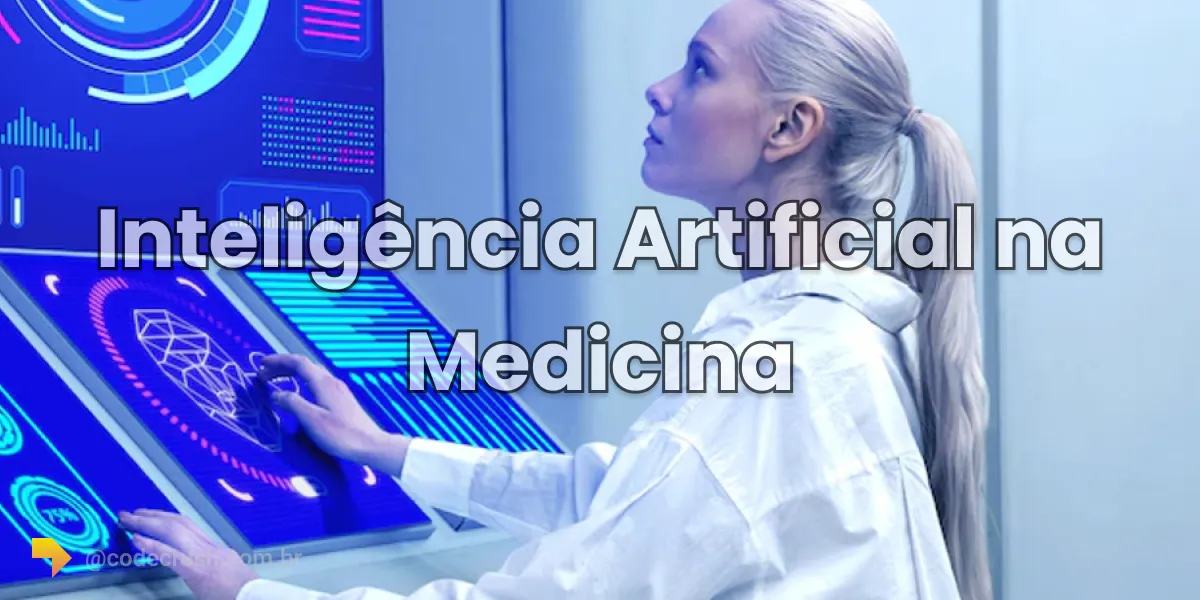
Artificial intelligence (AI) in medicine is more friend than threat: it accelerates diagnoses, personalizes treatments, and already operates in more than 1,250 FDA-authorized devices. The risks — algorithm error, bias, and privacy — are real, but manageable with human supervision and adequate regulation.
- What is artificial intelligence in medicine?
- AI in medicine: friend or threat?
- What are the benefits of AI in medicine?
- AI-assisted diagnosis and treatment in practice
- What are the risks and ethical challenges of AI in health?
- The future of AI in medicine
- Conclusion
What is artificial intelligence in medicine?
Artificial intelligence in medicine is the application of machine learning algorithms and models to support diagnosis, treatment, and health management, used to analyze medical images, genetic data, and electronic health records at a scale and speed impossible for humans. According to the FDA (Food and Drug Administration) public list, more than 1,250 AI-enabled medical devices had already been authorized in the United States as of July 2025 — up from about 950 in August 2024, a growth of more than 30% in less than a year.
In practice, these systems process large volumes of clinical data to find patterns: a subtle spot on an X-ray, a combination of symptoms that suggests a rare disease, a genetic variant associated with hereditary risk. If you still confuse the concepts, it is worth understanding the difference between machine learning and artificial intelligence before diving into medical applications.
AI in medicine: friend or threat?
AI in medicine is predominantly an ally of health professionals: it does not replace clinical judgment, but expands diagnostic capacity, reduces errors from fatigue, and frees up physician time for the patient. The threat is not in the technology itself, but in its use without supervision, without regulation, and with biased data. The table below summarizes the two sides of each aspect:
| Aspect | Friendly side | Threat side |
|---|---|---|
| Diagnosis | Detects patterns invisible to the human eye | Algorithm error with clinical impact |
| Data | Processes millions of records in seconds | Leak of sensitive medical data |
| Equity | Expands access with virtual triage | Bias that discriminates against patient groups |
| Professionals | Reduces repetitive tasks and fatigue | Dependence and loss of clinical skills |
| Cost | Avoids unnecessary exams and treatments | Inequality between rich and poor institutions |
The balance depends on governance: with clinical validation, bias auditing, and clear accountability, the benefits outweigh the risks by a wide margin.
What are the benefits of AI in medicine?
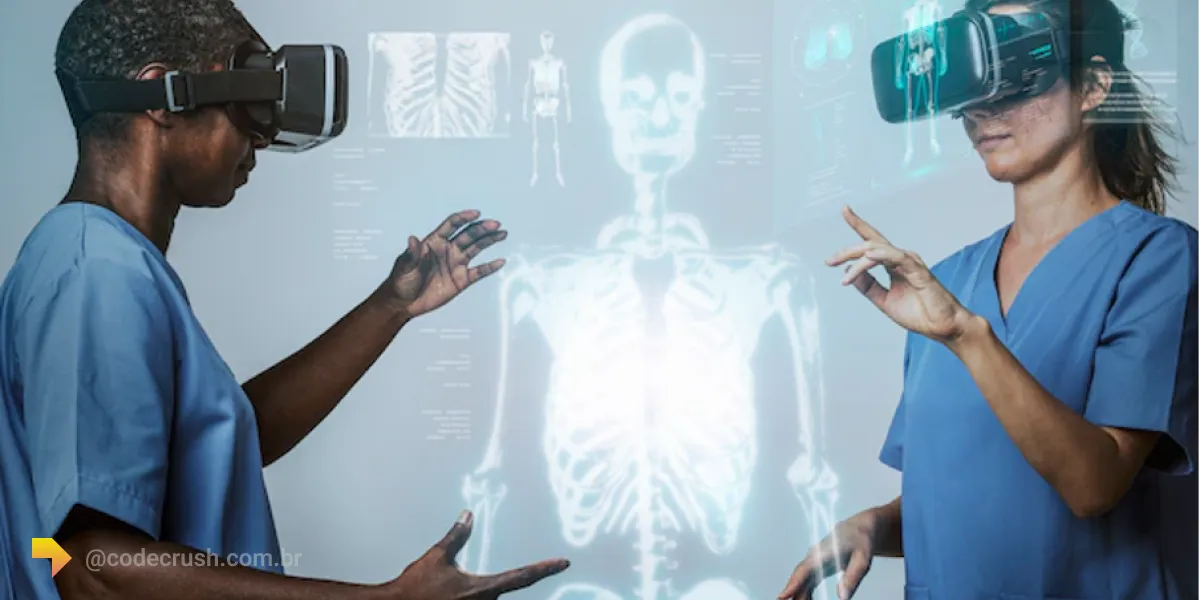
The central benefits of AI in medicine are diagnostic accuracy, analysis speed, and treatment personalization. The most cited example comes from breast cancer screening: the Google Health study published in Nature in January 2020 (McKinney et al.) showed that an AI system reduced false positives by 5.7% and false negatives by 9.4% on US data, outperforming the average of radiologists in reading mammograms.
The ability to process large amounts of data efficiently also changes the clinical routine. With access to relevant and up-to-date information, physicians make more informed decisions — and early diagnosis identifies patterns and symptoms that would go unnoticed, which translates into more effective treatments.
Another important benefit is genetic data analysis. Algorithms trained on genomes identify patterns related to hereditary diseases, helping physicians map people at higher risk of developing certain conditions and act preventively, before any symptom.
AI-assisted diagnosis and treatment in practice

Concrete examples of artificial intelligence applications in medicine have already left the laboratory. Machine learning algorithms analyze X-rays, CT scans, and MRIs to point out anomalies that the radiologist confirms or dismisses — it is precisely in this category that most FDA-authorized devices are concentrated.
At the entrance of the health system, automation chatbots provide virtual care: they answer patient questions, collect information about symptoms, and refer to in-person care when needed, relieving clinical teams.
In treatment, AI enables personalized therapies. Based on the genetic characteristics and medical history of each patient, systems suggest the most appropriate treatment for the individual, weighing expected efficacy and side effects — instead of a single protocol applied to all.
What are the risks and ethical challenges of AI in health?

The risks of AI in health are concentrated on four fronts: algorithm error, bias, privacy, and accountability. An algorithm that errs can have serious clinical consequences; a model trained on biased data reproduces and amplifies discrimination against patient groups; and excessive dependence on technology can erode essential medical skills.
The World Health Organization (WHO) published in 2021 the first global report on the topic, Ethics and governance of artificial intelligence for health, with six principles: protect human autonomy, promote well-being and safety, ensure transparency and explainability, foster accountability, ensure inclusion and equity, and promote responsive and sustainable AI. At the report launch, Director-General Tedros Adhanom Ghebreyesus summed up the dilemma: "Like any new technology, artificial intelligence has enormous potential to improve the health of millions of people around the world, but, like any technology, it can also be misused and cause harm".
Privacy is the most sensitive challenge for those developing these systems. AI models need large volumes of data to work, but health data is the most protected category under the LGPD (General Data Protection Law) — requiring rigorous information security practices, anonymization, and use restricted to medical purposes. And the question of liability remains open: when the system errs, the legal response still divides among physician, institution, and software manufacturer.
The future of AI in medicine
The future of AI in medicine points to research and drug discovery. With the ability to cross-reference genetic and clinical data at scale, AI systems identify new therapeutic targets and accelerate steps of drug development that previously took years — a path to more effective and cheaper treatments.
The symmetrical risk is inequality: not all health institutions have access to the same technologies, and AI can aggravate already existing disparities in the system. This is why the regulatory agenda — from the FDA, the WHO, and national authorities — advances alongside the technique. For developers, the message is clear: health is today one of the most promising frontiers of technology, and here at CodeCrush the topic appears frequently precisely because it combines data, ethics, and real impact on people lives.
Conclusion
The "friend or threat?" question has a practical answer: AI in medicine is a friend as long as there is a human in the loop. The numbers — more than 1,250 FDA-authorized devices and measurable diagnostic accuracy gains published in Nature — show the benefit is concrete, not a promise. What separates good use from harm is not the algorithm, but governance: serious regulation, bias auditing, data protection, and physicians who validate, rather than just accept, what the machine suggests. Those who build or adopt these tools should treat the six WHO principles as a project requirement, not as an ethical appendix.
Recommended for this topic
Picked by the editors — only what we would use.
MultGo Oficial
Hub USB 3.0 Tipo C Adaptador 4 em 1 Premium Alta Velocidade de Transmissão
A Casa dos Importados
Hub Usb 2.0 c/7 Portas Pen Drive Teclado 480mbps Hd
Bookcenter RJ
Kit Upgrade INTEL I5 4570 + Placa Intel H81 + Memória 8 GB+ Cooler
## faq
Frequently asked questions
Will artificial intelligence replace doctors?
No. AI acts as a clinical decision support tool: it analyzes exams, suggests diagnoses, and prioritizes cases, but the final responsibility remains with the physician. The WHO recommends human supervision as a central principle, and current regulation requires clinical validation before any autonomous use.
How is AI used in medicine today?
The most mature applications are medical image analysis (X-rays, MRIs, mammograms), patient triage with chatbots, support for early diagnosis, genetic data analysis, and drug discovery. The FDA has already authorized more than 1,250 AI-enabled medical devices, most in radiology.
What are the main risks of AI in health?
The central risks are algorithm errors with clinical consequences, bias in training data that discriminates against patient groups, leaks of sensitive medical data, excessive dependence on technology, and inequality of access between institutions. All require continuous regulation, auditing, and human supervision.
Who is responsible when AI gets a diagnosis wrong?
There is still no global legal consensus. In practice, responsibility is distributed among the physician who validates the decision, the institution that adopts the system, and the software manufacturer. The WHO advocates clear accountability and redress mechanisms as a mandatory ethical principle of AI in health.
Is it worth working with AI in health in 2026?
Yes. The sector grows fast — the number of FDA-authorized AI devices jumped from about 950 in 2024 to more than 1,250 in 2025 — and demands developers, data scientists, and machine learning specialists who understand regulation, privacy, and clinical data.
Topics in this article
## continue lendo
Artigos relacionados

Keep browsing
Previous article

Virtual Reality in Rehabilitation: How It Works
Virtual reality in rehabilitation uses immersive environments to accelerate motor and neurological recovery, raising patient motivation and safety.
Read moreNext article

Linear Regression types: simple, multiple, Ridge, and Lasso
Meet the types of linear regression — simple, multiple, polynomial, Ridge, and Lasso — with equations, use cases, and criteria for choosing the right model.
Read moreAbout the author